Loading...
Searching...
No Matches
Mila::Data::BpeVocabulary Class Referenceexport
module Data.BpeVocabulary
Unified Byte Pair Encoding (BPE) vocabulary. More...
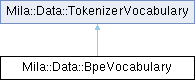
Inheritance diagram for Mila::Data::BpeVocabulary:
Public Member Functions | |
| bool | containsToken (const std::string &token) const |
| Raw vocabulary membership test (no UNK fallback). | |
| const BpeVocabularyConfig & | getConfig () const |
| std::optional< size_t > | getMergePriority (const std::string &left, const std::string &right) const |
| const std::vector< std::pair< std::string, std::string > > & | getMergeRules () const |
| size_t | getSize () const override |
| Get the number of tokens in the vocabulary. | |
| std::optional< TokenId > | getSpecialTokenId (const std::string &token_str) const |
| Look up a special token ID by its string representation. | |
| const std::vector< std::pair< std::string, TokenId > > & | getSpecialTokenList () const |
| Return the special token list sorted longest-first. | |
| std::optional< std::string > | idToToken (TokenId id) const override |
| Map a numeric id back to its token string. | |
| bool | isByteLevel () const |
| void | save (const fs::path &path) const override |
| Serialize the vocabulary to Mila binary format (content version 2). | |
| std::optional< TokenId > | tokenToId (const std::string &token) const override |
| Convert a token string to its ID. | |
| Public Member Functions inherited from Mila::Data::TokenizerVocabulary | |
| virtual | ~TokenizerVocabulary ()=default |
| Virtual destructor. | |
| virtual void | save (const std::filesystem::path &path) const =0 |
| Serialize the vocabulary to disk at the given path. | |
Static Public Member Functions | |
| static const std::unordered_map< std::string, unsigned char > & | getByteDecoder () |
| static const std::unordered_map< unsigned char, std::string > & | getByteEncoder () |
| static BpeVocabulary | load (const fs::path &path) |
| Load a vocabulary from Mila binary format (version 2). | |
| static BpeVocabulary | loadGemma (const fs::path &path) |
| Load a pretrained Gemma 4 (SentencePiece BPE) vocabulary. | |
| static BpeVocabulary | loadGpt2 (const fs::path &tokenizer_path) |
| Load a pretrained GPT-2 vocabulary. | |
| static BpeVocabulary | loadLlama32 (const fs::path &path) |
| Load a pretrained Llama 3.2 vocabulary. | |
| static BpeVocabulary | loadMistral (const fs::path &vocab_path, const fs::path &merges_path) |
| Load a pretrained Mistral vocabulary. | |
| static BpeVocabulary | loadQwen (const fs::path &path) |
| Load a pretrained Qwen 3.x (byte-level BPE) vocabulary. | |
| static BpeVocabulary | train (const std::string &corpus, const BpeVocabularyConfig &config) |
| Train a BPE vocabulary from a text corpus. | |
| static BpeVocabulary | trainFromFile (const fs::path &corpus_path, const BpeVocabularyConfig &config) |
| Train a BPE vocabulary from a corpus file. | |
Detailed Description
Unified Byte Pair Encoding (BPE) vocabulary.
Immutable after construction; safe for concurrent reads. Supports training from scratch via BpeTrainer, or loading pretrained vocabularies from:
- Mila binary format produced by save() (load)
- GPT-2 binary produced by convert_gpt2_tokenizer.py (loadGpt2)
- Llama 3.2 binary produced by convert_llama_tokenizer.py (loadLlama32)
- Gemma 4 binary produced by Gemma/convert_tokenizer.py (loadGemma)
- Qwen 3.x binary produced by Qwen/convert_tokenizer.py (loadQwen)
Special tokens are keyed on their string representation (e.g., "<|endoftext|>", "<|begin_of_text|>") and exposed via getSpecialTokenList() for O(n) pre-pass scanning in BpeTokenizer. Extended special tokens from SpecialTokens are registered automatically.
Member Function Documentation
◆ containsToken()
|
inline |
Raw vocabulary membership test (no UNK fallback).
Unlike tokenToId(), this never substitutes the UNK id, so the SentencePiece encode path can ask "is this exact piece in the vocab?" to decide between using a character directly and byte-fallback.
◆ getSize()
|
inlineoverridevirtual |
Get the number of tokens in the vocabulary.
- Returns
- size_t Number of entries (tokens) present in the vocabulary.
Implements Mila::Data::TokenizerVocabulary.
◆ getSpecialTokenId()
|
inline |
Look up a special token ID by its string representation.
Used by BpeTokenizer's encode pre-pass to resolve tokens such as "<|endoftext|>" or "<|begin_of_text|>" directly to IDs before BPE runs.
- Parameters
-
token_str Token string to look up.
- Returns
- Token ID if registered as special, nullopt otherwise.
◆ getSpecialTokenList()
|
inline |
Return the special token list sorted longest-first.
Ordered longest-first so BpeTokenizer's linear scan matches longer tokens before any of their prefixes (e.g., "<|begin_of_text|>" before "<|").
- Returns
- Vector of (token_string, token_id) pairs.
◆ idToToken()
|
inlineoverridevirtual |
Map a numeric id back to its token string.
Returns an empty optional if the id is out of range or not defined.
- Parameters
-
id Token id to convert.
- Returns
- std::optional<std::string> The token string if present, otherwise empty.
Implements Mila::Data::TokenizerVocabulary.
◆ load()
|
inlinestatic |
Load a vocabulary from Mila binary format (version 2).
Reads a file written by save(). Special tokens are restored from the serialized (string, id) pairs and the special token list is rebuilt automatically.
- Parameters
-
path Input file path.
- Returns
- Loaded BpeVocabulary instance.
- Exceptions
-
std::runtime_error on I/O errors or format mismatch.
◆ loadGemma()
|
static |
Load a pretrained Gemma 4 (SentencePiece BPE) vocabulary.
Reads the Gemma-extended binary produced by convert_tokenizer.py:
Header: vocab_size (uint32), use_byte_fallback (uint8),
model_type (uint8: 1=BPE, 2=Unigram), num_merges (uint32)
For each token: token_length (uint32), token_bytes, score (float32), token_id (uint32)
For each merge: left_length (uint32), left, right_length (uint32), right
has_bos/eos/pad/unk (uint32) + id (uint32, conditional)
Configures the SentencePiece runtime: byte_level=false (pieces are raw UTF-8 with U+2581 for spaces) and PreTokenizationMode::SentencePiece. The instruct turn-boundary tokens are registered from the loaded vocab.
- Parameters
-
path Path to the converted Gemma tokenizer binary.
- Exceptions
-
std::runtime_error on I/O errors or an unsupported (Unigram) model type.
◆ loadGpt2()
|
static |
Load a pretrained GPT-2 vocabulary.
Reads the binary format produced by convert_gpt2_tokenizer.py:
vocab_size (uint32)
num_merges (uint32)
For each token: token_length (uint32), token_bytes (utf-8), token_id (uint32)
For each merge: left_length (uint32), left, right_length (uint32), right
has_eos (uint32), eos_id (uint32, conditional)
has_bos (uint32), bos_id (uint32, conditional)
has_pad (uint32), pad_id (uint32, conditional)
- Parameters
-
tokenizer_path Path to the converted GPT-2 tokenizer binary.
- Returns
- Loaded BpeVocabulary instance.
- Exceptions
-
std::runtime_error on I/O or format errors.
◆ loadLlama32()
|
static |
Load a pretrained Llama 3.2 vocabulary.
Reads the binary format produced by convert_llama_tokenizer.py:
Header: vocab_size (uint32), use_byte_fallback (uint8)
For each token: token_length (uint32), token_bytes, score (float32), token_id (uint32)
has_bos (uint32), bos_id (uint32, conditional) -- 128000
has_eos (uint32), eos_id (uint32, conditional) -- 128001
has_pad (uint32), pad_id (uint32, conditional)
has_unk (uint32), unk_id (uint32, conditional) -- absent for Llama 3.2
Llama 3.x vocabularies carry no explicit BPE merges; the merge order is encoded implicitly in the token ID assignment.
- Parameters
-
path Path to the converted Llama 3.2 tokenizer binary.
- Returns
- Loaded BpeVocabulary instance.
- Exceptions
-
std::runtime_error on I/O or format errors.
◆ loadMistral()
|
static |
◆ loadQwen()
|
static |
Load a pretrained Qwen 3.x (byte-level BPE) vocabulary.
Reads the same binary layout loadGemma does, produced by Qwen/convert_tokenizer.py:
Header: vocab_size (uint32), use_byte_fallback (uint8),
model_type (uint8: 1=BPE), num_merges (uint32)
For each token: token_length (uint32), token_bytes, score (float32), token_id (uint32)
For each merge: left_length (uint32), left, right_length (uint32), right
has_bos/eos/pad/unk (uint32) + id (uint32, conditional)
Configures the GPT-2 byte-level runtime (byte_level=true, the GPT-2 byte encoder) with Qwen's own split pattern, and takes the merge-by-rank path rather than Llama's max-munch: Qwen's ignore_merges is false and its vocabulary is not max-munch equivalent. Chat, thinking and tool-calling markers are registered from the loaded vocabulary.
- Parameters
-
path Path to the converted Qwen tokenizer binary.
- Exceptions
-
std::runtime_error on I/O errors or a non-BPE model type.
◆ save()
|
inlineoverride |
Serialize the vocabulary to Mila binary format (content version 2).
Writes a MilaFileHeader followed by the vocabulary content. Special tokens are stored as (string_length, string, token_id) triples, eliminating the char-key indirection used in the former GPT-2-only format.
- Parameters
-
path Output file path. Parent directory must exist.
- Exceptions
-
std::runtime_error on I/O errors.
◆ tokenToId()
|
inlineoverridevirtual |
Convert a token string to its ID.
Falls back to the UNK token ID when the token is not found and use_unk is enabled (GPT-2 style). Llama 3.x vocabularies return nullopt on a miss because they rely on byte-level fallback rather than an UNK token.
- Parameters
-
token UTF-8 encoded token string.
- Returns
- Token ID, UNK ID (if enabled), or nullopt on miss.
Implements Mila::Data::TokenizerVocabulary.
◆ train()
|
inlinestatic |
Train a BPE vocabulary from a text corpus.
- Parameters
-
corpus Training text. config Vocabulary configuration; config.validate() is called internally.
- Returns
- Trained BpeVocabulary instance.
- Exceptions
-
std::invalid_argument if config fails validation.
◆ trainFromFile()
|
inlinestatic |
Train a BPE vocabulary from a corpus file.
- Parameters
-
corpus_path Path to a UTF-8 text corpus file. config Vocabulary configuration.
- Returns
- Trained BpeVocabulary instance.
- Exceptions
-
std::runtime_error if the file cannot be opened. std::invalid_argument if config fails validation.
The documentation for this class was generated from the following file:
- Mila/Src/Data/Tokenizers/Bpe/BpeVocabulary.ixx
