Loading...
Searching...
No Matches
Mila::Dnn::GemmaModel< TDeviceType, TPrecision > Class Template Referenceexport
module Dnn.Models.GemmaModel
Gemma 4 compatible inference model. More...
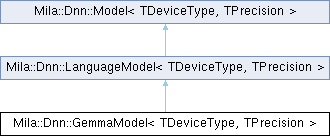
Inheritance diagram for Mila::Dnn::GemmaModel< TDeviceType, TPrecision >:
Public Types | |
| using | GemmaSlidingKvPolicy = Quant::KvCache::SlidingWindowKvCache |
| KV policy for Gemma's LOCAL (sliding) layers. | |
| using | ModelBase = LanguageModel<TDeviceType, TPrecision> |
| using | MR = typename DeviceTypeTraits<TDeviceType>::memory_resource |
| using | TensorType = Tensor<TPrecision, MR> |
| using | TokenIndexType = Tensor<dtype_t::INT32, MR> |
| Public Types inherited from Mila::Dnn::LanguageModel< TDeviceType, TPrecision > | |
| using | Base = Model<TDeviceType, TPrecision> |
| Public Types inherited from Mila::Dnn::Model< TDeviceType, TPrecision > | |
| using | NetworkType = Network<TDeviceType, TPrecision> |
Public Member Functions | |
| GemmaModel (const GemmaModel &)=delete | |
| GemmaModel (GemmaModel &&)=default | |
| dim_t | contextLength () const noexcept |
| Deployment context length: the KV-cache depth the network was built with. | |
| const GemmaModelConfig & | getModelConfig () const noexcept |
| Deployment configuration (context length, weight-quant, kv-compression) this model was loaded with. | |
| const GemmaConfig & | getNetworkConfig () const noexcept |
| Architecture/network configuration (read from the checkpoint metadata). | |
| GemmaModel & | operator= (const GemmaModel &)=delete |
| GemmaModel & | operator= (GemmaModel &&)=default |
| std::string | toString () const override |
| Human-readable summary of this model's configuration. | |
| Public Member Functions inherited from Mila::Dnn::LanguageModel< TDeviceType, TPrecision > | |
| LanguageModel (const LanguageModel &)=delete | |
| LanguageModel (LanguageModel &&)=default | |
| std::vector< std::string > | componentPaths () const |
| Every observable component path, for choosing a pattern or diagnosing a zero. | |
| GenerateStatus | generate (std::span< const int32_t > prompt_tokens, const std::function< void(int32_t)> &on_token, const GenerateParams ¶ms={}, std::stop_token stop={}) |
| Generate tokens from a prompt, streaming each through on_token. | |
| size_t | observe (std::string_view pattern, Compute::ComputePassMask passes, Compute::ActivationObserver sink) |
| Watch activations flowing through matching components on matching passes. | |
| LanguageModel & | operator= (const LanguageModel &)=delete |
| LanguageModel & | operator= (LanguageModel &&)=default |
| void | save (const std::filesystem::path &path) const |
| Write this model's live weights as a safetensors weights file. | |
| void | seedSampler (uint64_t seed) |
| Seed the sampler's RNG for reproducible generation. | |
| void | stopObserving () |
| Detach every observer and clear the sink. A probe that outlives its question costs. | |
| std::string | weightQuantizationScheme () const |
| The scheme name save records for these weights, e.g. | |
| Public Member Functions inherited from Mila::Dnn::Model< TDeviceType, TPrecision > | |
| Model (const Model &)=delete | |
| Model (Model &&)=default | |
| DeviceId | getDeviceId () const noexcept |
| The device this model runs on. | |
| MemoryStats | getMemoryStats () const |
| Current memory allocation breakdown for this model. | |
| RuntimeMode | getRuntimeMode () const noexcept |
| The runtime mode this model was constructed for. | |
| bool | isEval () const noexcept |
| True if this model is currently in eval sub-state. | |
| bool | isInferenceMode () const noexcept |
| True if this model was constructed for inference. | |
| bool | isTrainingMode () const noexcept |
| True if this model was constructed for training. | |
| Model & | operator= (const Model &)=delete |
| Model & | operator= (Model &&)=default |
| void | setEval (bool eval) |
| Toggle eval sub-state for this model. | |
| void | train () |
| Run the training loop for this model. | |
Static Public Member Functions | |
| static GemmaConfig | configFromMetadata (const WeightsMetadata &metadata) |
| The network geometry a load of this file builds. | |
| static DeploymentFootprint | getDeploymentFootprint (const std::filesystem::path &path, const GemmaModelConfig &model_config, DeviceId device_id=DeviceId{ TDeviceType, 0 }) |
| The same prediction, plus how this deployment would chunk its prefill. | |
| static MemoryStats | getRequiredMemory (const std::filesystem::path &path, const GemmaModelConfig &model_config, DeviceId device_id=DeviceId{ TDeviceType, 0 }) |
| What loading this checkpoint at this context length would cost in VRAM. | |
| static std::unique_ptr< GemmaModel< TDeviceType, TPrecision > > | load (const std::filesystem::path &path, const GemmaModelConfig &model_config, DeviceId device_id=DeviceId{ TDeviceType, 0 }) |
| Load Gemma 4 from a Mila weights file. | |
Protected Member Functions | |
| dim_t | maxSequenceLength () const noexcept override |
| GenerateStatus | onGenerating (std::span< const int32_t > prompt_tokens, const std::function< void(int32_t)> &on_token, const GenerateParams ¶ms, std::stop_token stop) override |
| Prefill + decode implementation hook. | |
| void | onTraining () override |
| Training loop hook – derived class owns the implementation. | |
| dim_t | vocabSize () const noexcept override |
| Protected Member Functions inherited from Mila::Dnn::LanguageModel< TDeviceType, TPrecision > | |
| LanguageModel (std::unique_ptr< LanguageModelNetwork< TDeviceType, TPrecision > > network, RuntimeMode runtime_mode, Serialization::WeightsMetadata source_metadata={}, WeightQuantization weight_quantization=WeightQuantization::None, int fp4_group_size=128) | |
| int32_t | awaitSampledToken () |
| Block until the last enqueueSampleNext()'s token id is host-visible. | |
| void | enqueueSampleNext (const TensorType &logits, TokenTensor &token_out, const SamplingParams ¶ms) |
| Enqueue a sampling step without waiting for the host readback. | |
| const LanguageModelNetwork< TDeviceType, TPrecision > & | getNetwork () const noexcept |
| LanguageModelNetwork< TDeviceType, TPrecision > & | getNetwork () noexcept |
| int32_t | sampleNext (const TensorType &logits, TokenTensor &token_out, const SamplingParams ¶ms) |
| Sample the next token from a logits row on the device. | |
| Protected Member Functions inherited from Mila::Dnn::Model< TDeviceType, TPrecision > | |
| Model (std::unique_ptr< NetworkType > network, RuntimeMode runtime_mode) | |
| Construct with a fully built network and runtime mode. | |
Additional Inherited Members | |
| Protected Types inherited from Mila::Dnn::LanguageModel< TDeviceType, TPrecision > | |
| using | MR = typename DeviceTypeTraits<TDeviceType>::memory_resource |
| using | TensorType = Tensor<TPrecision, MR> |
| using | TokenTensor = Tensor<TensorDataType::INT32, MR> |
| Protected Attributes inherited from Mila::Dnn::LanguageModel< TDeviceType, TPrecision > | |
| int | fp4_group_size_ { 128 } |
| The FP4 group the live weights were built at; meaningful only when they are FP4. | |
| Serialization::WeightsMetadata | source_metadata_ |
| The loaded weights file's metadata, carried so save can write it back verbatim. | |
| WeightQuantization | weight_quantization_ { WeightQuantization::None } |
| What the live weights are, not what the source file was. | |
| Protected Attributes inherited from Mila::Dnn::Model< TDeviceType, TPrecision > | |
| std::unique_ptr< NetworkType > | network_ |
| The owned Network instance. | |
Detailed Description
template<DeviceType TDeviceType, TensorDataType TPrecision>
requires PrecisionSupportedOnDevice<TPrecision, TDeviceType>
class Mila::Dnn::GemmaModel< TDeviceType, TPrecision >
requires PrecisionSupportedOnDevice<TPrecision, TDeviceType>
class Mila::Dnn::GemmaModel< TDeviceType, TPrecision >
Gemma 4 compatible inference model.
Owns a loaded, built GemmaTransformer and drives the prefill + KV-cache decode two-phase generation loop. Construction is only possible via load(); the network is always built, weights-loaded, and in inference mode when generation runs.
Thread safety: not thread-safe; external synchronization required if shared.
Member Typedef Documentation
◆ GemmaSlidingKvPolicy
template<DeviceType TDeviceType, TensorDataType TPrecision>
| using Mila::Dnn::GemmaModel< TDeviceType, TPrecision >::GemmaSlidingKvPolicy = Quant::KvCache::SlidingWindowKvCache |
KV policy for Gemma's LOCAL (sliding) layers.
Bounded sliding-window ring (SlidingWindowKvCache.md Phase 3): their cache is sized to the window working set instead of the full context. Strictly a memory optimization – tokens are identical to the full cache. GLOBAL (full-attention) layers are always NoKvCompression, hardwired in GemmaTransformer. Flip this alias to NoKvCompression to A/B the footprint against the full-context sliding cache.
Class scope rather than per-function so the load and footprint paths cannot be pointed at different policies – that would make a model report a figure for a cache it does not build.
Member Function Documentation
◆ configFromMetadata()
template<DeviceType TDeviceType, TensorDataType TPrecision>
|
inlinestatic |
The network geometry a load of this file builds.
Public so a caller that constructs blocks itself – the layer-streamed parity harness – uses the geometry a real load would, rather than a second reading of the metadata.
◆ getDeploymentFootprint()
template<DeviceType TDeviceType, TensorDataType TPrecision>
|
inlinestatic |
The same prediction, plus how this deployment would chunk its prefill.
One graph construction answers both, because they are two readings of the same arithmetic – the chunk is resolved on the way to sizing the activation workspaces getRequiredMemory reports, and was previously discarded there.
The second half is what a caller choosing a context length needs and memory alone cannot tell it: the largest context that fits can be one where the chunk has walked down to its floor, because a longer context leaves less of the free memory for the chunk. See Specifications/MemoryFootprint.md section 11.
- Exceptions
-
std::invalid_argument on device type mismatch or zero context length. std::runtime_error on an unreadable artifact or unsupported quantization.
◆ getRequiredMemory()
template<DeviceType TDeviceType, TensorDataType TPrecision>
|
inlinestatic |
What loading this checkpoint at this context length would cost in VRAM.
Reads the artifact header for geometry and constructs the graph, then reports what build() would allocate – without building it, without reading a weight, and therefore without needing the device to have room. Answers before a multi-gigabyte download and for hardware the caller does not own.
Returns measurements only. Whether a given headroom is too tight is a deployment policy and belongs to the adaptor, not here; on Windows in particular WDDM oversubscribes rather than failing, so "fits" is not a property the runtime can decide. See Specifications/MemoryFootprint.md.
- Exceptions
-
std::invalid_argument on device type mismatch or zero context length. std::runtime_error on an unreadable artifact or unsupported quantization.
◆ load()
template<DeviceType TDeviceType, TensorDataType TPrecision>
|
inlinestatic |
Load Gemma 4 from a Mila weights file.
The model_config carries the deployment decisions (context length, weight quantization, KV-cache compression); every architectural parameter is read from the checkpoint metadata.
- Parameters
-
path Path to the Gemma weights file. model_config Deployment configuration for this load. device_id Target device; must match TDeviceType.
- Returns
- Inference-ready GemmaModel.
- Exceptions
-
std::invalid_argument on device type mismatch or zero context length. std::runtime_error on load failure or unsupported quantization.
◆ maxSequenceLength()
template<DeviceType TDeviceType, TensorDataType TPrecision>
|
inlineoverrideprotectedvirtualnoexcept |
◆ onGenerating()
template<DeviceType TDeviceType, TensorDataType TPrecision>
|
inlineoverrideprotectedvirtual |
Prefill + decode implementation hook.
Derived classes own the full autoregressive generation loop. on_token must be called for every generated token except EOS. stop.stop_requested() must be checked on each decode step and generation must abort early when signalled, returning the GenerateStatus that reflects why the loop stopped.
- Parameters
-
prompt_tokens Input token ids. on_token Per-token callback. params Per-call generation parameters (loop bound + sampling). stop Stop token for cooperative cancellation.
- Returns
- Why generation stopped.
Implements Mila::Dnn::LanguageModel< TDeviceType, TPrecision >.
◆ onTraining()
template<DeviceType TDeviceType, TensorDataType TPrecision>
|
inlineoverrideprotectedvirtual |
Training loop hook – derived class owns the implementation.
Called by train() after precondition enforcement. The derived class has total control over data loading, optimizer construction, loss computation, backward pass, checkpointing, and sampling.
Pure virtual – a model declaring RuntimeMode::Training must provide a training loop.
Implements Mila::Dnn::Model< TDeviceType, TPrecision >.
◆ toString()
template<DeviceType TDeviceType, TensorDataType TPrecision>
|
inlineoverridevirtual |
Human-readable summary of this model's configuration.
Implements Mila::Dnn::Model< TDeviceType, TPrecision >.
◆ vocabSize()
template<DeviceType TDeviceType, TensorDataType TPrecision>
|
inlineoverrideprotectedvirtualnoexcept |
The documentation for this class was generated from the following file:
- Mila/Src/Dnn/Models/Gemma/GemmaModel.ixx