Loading...
Searching...
No Matches
Mila::Dnn::Lpe< TDeviceType, TIndex, TPrecision > Class Template Referenceexport
module Dnn.Components.Lpe
Encoder module for token and positional embeddings (device-templated). More...
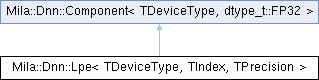
Inheritance diagram for Mila::Dnn::Lpe< TDeviceType, TIndex, TPrecision >:
Public Types | |
| using | ComponentBase = Component<TDeviceType, TPrecision> |
| using | EmbeddingsTensorType = Tensor<TPrecision, MR> |
| using | MR = typename DeviceTypeTraits<TDeviceType>::memory_resource |
| using | TokenIndexType = Tensor<TIndex, MR> |
Public Member Functions | |
| Lpe (const std::string &name, const LpeConfig &config, std::optional< DeviceId > device_id=std::nullopt) | |
| Construct Encoder component. | |
| TokenIndexType & | backward (const TokenIndexType &input, const EmbeddingsTensorType &output_grad) |
| Backward pass - compute parameter gradients and return owned input-grad. | |
| EmbeddingsTensorType & | decode (const TokenIndexType &input, dim_t position) |
| Decode pass - single token embedding at a specific sequence position. | |
| EmbeddingsTensorType & | forward (const TokenIndexType &input) |
| Forward pass - returns component-owned embeddings tensor. | |
| DeviceId | getDeviceId () const override |
| Get the compute device id associated with this component. | |
| int64_t | getEmbeddingDim () const noexcept |
| std::vector< ITensor * > | getGradients () const override |
| Return non-owning pointers to parameter gradient tensors. | |
| int64_t | getMaxSequenceLength () const noexcept |
| MemoryStats | getMemoryStats () const override |
| Return the current memory allocation breakdown for this component. | |
| std::vector< ObservableStage > | getObservableStages () const override |
| Stages this component publishes, and the passes each is published on. | |
| std::vector< const ITensor * > | getOutputs () const override |
| Return non-owning pointers to the tensors this component produces. | |
| std::vector< std::string > | getParameterNames () const override |
| List all available parameter names for this component. | |
| std::vector< ITensor * > | getParameters () const override |
| Return non-owning pointers to parameter tensors. | |
| const ComponentType | getType () const override |
| Get the component type identifier. | |
| int64_t | getVocabularyLength () const noexcept |
| EmbeddingsTensorType * | getWpeGrad () const noexcept |
| EmbeddingsTensorType * | getWteGrad () const noexcept |
| void | loadParameter (const std::string &name, const ITensorBlob &blob) override |
| Load a parameter from serialized tensor data. | |
| dim_t | parameterCount () const override |
| Return number of trainable parameters. | |
| void | save_ (ModelArchive &archive, SerializationMode mode) const override |
| void | saveFlatTensors (Serialization::SafeTensorsWriter &writer, const std::string &prefix, Serialization::TensorSavePass pass) const override |
| Drive this component's tensors through one pass of a flat safetensors save. | |
| void | synchronize () override |
| Wait for outstanding device work submitted by this component. | |
| std::string | toString () const override |
| Produce a short, human-readable description of the component. | |
| void | zeroGradients () override |
| Clear all model-owned gradients for this component. | |
| Public Member Functions inherited from Mila::Dnn::Component< TDeviceType, dtype_t::FP32 > | |
| Component (const std::string &name) | |
| Construct component with required name identifier. | |
| virtual void | build (const BuildContext &context) final |
| Build the component with the provided BuildContext (canonical overload). | |
| IExecutionContext * | getExecutionContext () const |
| Get the shared execution context. | |
| const std::string | getName () const |
| Get the component's name identifier. | |
| Compute::ComputePassMask | getObservedPasses () const noexcept |
| virtual MemoryStats | getRequiredMemory (const BuildContext &context) const |
| Report what build( context ) would allocate, without allocating it. | |
| RuntimeMode | getRuntimeMode () const noexcept |
| TrainingMode | getTrainingMode () const noexcept |
| The current runtime behavioral mode of this Component. | |
| virtual bool | isBuilt () const final |
| Returns true if build() has completed successfully. | |
| bool | isInferenceMode () const noexcept |
| bool | isTrainingMode () const noexcept |
| virtual void | load_ (ModelArchive &archive, SerializationMode mode) |
| Restore this component's parameters from its archive scope. | |
| virtual void | requireSerializableParameters () const |
| Verify this component can serialize whatever parameters it owns. | |
| void | setObservedPasses (Compute::ComputePassMask passes) noexcept |
| Select which passes this component publishes on. | |
| void | setTrainingMode (TrainingMode mode) |
| Set the runtime behavioral mode for this Component. | |
Protected Member Functions | |
| void | onBuilding (const BuildContext &build_config) override |
| Hook invoked by build() to allocate component buffers. | |
| void | onExecutionContextSet () override |
| Called after ExecutionContext is set on the base Component. | |
| void | onTrainingModeChanging (TrainingMode training_mode) override |
| Hook called before TrainingMode transitions. | |
| Protected Member Functions inherited from Mila::Dnn::Component< TDeviceType, dtype_t::FP32 > | |
| bool | hasExecutionContext () const noexcept |
| Check if execution context has been set. | |
| void | loadParameterFromBlob (const std::string ¶m_name, const Serialization::ITensorBlob &blob, Tensor< TParameterPrecision, TMemoryResource > &target, const shape_t &expected_shape) |
| Load a tensor blob into a parameter tensor with validation. | |
| void | publish (Compute::ComputePass pass, std::string_view stage, const ITensor &value) const |
| Publish one activation to the observer, if this pass is being observed. | |
| void | saveParameterToArchive (ModelArchive &archive, const std::string ¶meter_name, const Tensor< TParameterPrecision, TMemoryResource > ¶meter) const |
| Write one parameter tensor into the archive under "tensors/<name>". | |
| void | saveParameterToWriter (Serialization::SafeTensorsWriter &writer, const std::string &flat_name, const Tensor< TParameterPrecision, TMemoryResource > ¶meter, Serialization::TensorSavePass pass) const |
| Drive one parameter through one pass of a flat safetensors save. | |
| void | setExecutionContext (IExecutionContext *context) |
| Set the execution context for this component. | |
Additional Inherited Members | |
| Static Public Member Functions inherited from Mila::Dnn::Component< TDeviceType, dtype_t::FP32 > | |
| static constexpr DeviceType | getDeviceType () |
| Compile-time device type for this component instance. | |
| static constexpr TensorDataType | getPrecision () noexcept |
| Compile-time tensor precision for this component instance. | |
| Protected Types inherited from Mila::Dnn::Component< TDeviceType, dtype_t::FP32 > | |
| using | HostStagingMemoryResource |
| Host memory a device-resident parameter stages through. | |
| Protected Attributes inherited from Mila::Dnn::Component< TDeviceType, dtype_t::FP32 > | |
| BuildContext | build_context_ |
| The BuildContext stored at build time. | |
Detailed Description
template<DeviceType TDeviceType, TensorDataType TIndex = dtype_t::INT32, TensorDataType TPrecision = dtype_t::FP32>
requires PrecisionSupportedOnDevice<TPrecision, TDeviceType>
class Mila::Dnn::Lpe< TDeviceType, TIndex, TPrecision >
requires PrecisionSupportedOnDevice<TPrecision, TDeviceType>
class Mila::Dnn::Lpe< TDeviceType, TIndex, TPrecision >
Encoder module for token and positional embeddings (device-templated).
Delegates computation to a device-specific UnaryOperation implementation registered in the OperationRegistry.
The Encoder transforms input token IDs into continuous vector representations:
- Looks up token embeddings from vocabulary table (wte)
- Adds positional embeddings (wpe) based on sequence position
Module owns trainable parameters (wte, wpe) and exposes them via accessors. The operation implements embedding lookup and position encoding addition.
Construction modes:
- Standalone: provide a DeviceId to create and own an ExecutionContext.
- Deferred/shared: omit DeviceId and caller must call setExecutionContext() before build().
- Template Parameters
-
TDeviceType Device type (DeviceType::Cpu or DeviceType::Cuda) TIndex Data type for token indices (typically INT32) TPrecision Abstract tensor precision (TensorDataType) for embeddings
Constructor & Destructor Documentation
◆ Lpe()
template<DeviceType TDeviceType, TensorDataType TIndex = dtype_t::INT32, TensorDataType TPrecision = dtype_t::FP32>
|
inlineexplicit |
Construct Encoder component.
Two modes:
- Standalone mode: provide DeviceId and component will create and own an ExecutionContext.
- Child mode: omit DeviceId and parent must call setExecutionContext() before build().
- Parameters
-
name Component name identifier (mandatory) config Encoder configuration device_id Optional DeviceId to create owned ExecutionContext (standalone mode)
Member Function Documentation
◆ backward()
template<DeviceType TDeviceType, TensorDataType TIndex = dtype_t::INT32, TensorDataType TPrecision = dtype_t::FP32>
|
inline |
Backward pass - compute parameter gradients and return owned input-grad.
Token indices are discrete and not differentiable; the backend may still expect an input-gradient tensor. The component owns a token-index-typed input-gradient buffer that is passed to the backend and returned.
- Parameters
-
input Input token indices tensor used during forward. output_grad Gradient w.r.t. embeddings [B, T, C].
- Returns
- Reference to component-owned token-index-typed input-grad tensor.
- Exceptions
-
std::runtime_error if component is not built, not in training mode, or backend/buffers are not initialized.
◆ decode()
template<DeviceType TDeviceType, TensorDataType TIndex = dtype_t::INT32, TensorDataType TPrecision = dtype_t::FP32>
|
inline |
Decode pass - single token embedding at a specific sequence position.
Unlike forward() which processes a full sequence [B, T] and uses positions 0..T-1, decode() processes a single token and uses the caller-supplied position for the positional embedding lookup. This is critical for correctness in KV cache autoregressive generation – without the correct position, wpe[0] would be used for every generated token, corrupting all subsequent attention computations.
- Parameters
-
input Single token index tensor [1, 1] position Actual sequence position (prefill_len + decode_step)
- Returns
- Reference to component-owned embedding tensor [1, 1, C]
- Exceptions
-
std::runtime_error if component is not built.
◆ forward()
template<DeviceType TDeviceType, TensorDataType TIndex = dtype_t::INT32, TensorDataType TPrecision = dtype_t::FP32>
|
inline |
Forward pass - returns component-owned embeddings tensor.
- Parameters
-
input Input token indices tensor [B, T]
- Returns
- Reference to component-owned embeddings tensor [B, T, C]
- Exceptions
-
std::runtime_error if component is not built or backend not initialized.
◆ getDeviceId()
template<DeviceType TDeviceType, TensorDataType TIndex = dtype_t::INT32, TensorDataType TPrecision = dtype_t::FP32>
|
inlineoverridevirtual |
Get the compute device id associated with this component.
Must return the device on which parameters and operations execute.
Implements Mila::Dnn::Component< TDeviceType, dtype_t::FP32 >.
◆ getGradients()
template<DeviceType TDeviceType, TensorDataType TIndex = dtype_t::INT32, TensorDataType TPrecision = dtype_t::FP32>
|
inlineoverridevirtual |
Return non-owning pointers to parameter gradient tensors.
Gradient buffers are allocated only when the component is built in training mode, so a component built for inference returns an empty vector. Stateless components return empty in either mode. This is the accessor counterpart to getParameters() and does not throw on mode.
- Returns
- Vector of gradient pointers; empty when built for inference.
- Exceptions
-
std::runtime_error if called before the component has been built.
Implements Mila::Dnn::Component< TDeviceType, dtype_t::FP32 >.
◆ getMemoryStats()
template<DeviceType TDeviceType, TensorDataType TIndex = dtype_t::INT32, TensorDataType TPrecision = dtype_t::FP32>
|
inlineoverridevirtual |
Return the current memory allocation breakdown for this component.
Reflects allocations at the moment of the call. The returned stats naturally track the component lifecycle:
After construction – nothing; construction allocates none After build( Inference ) – parameters + T=1 state buffers After build( Training ) – parameters + T=full state buffers After setTrainingMode( Train ) – parameters + state + gradients
For CompositeComponent and Network, the returned stats are the recursive aggregate of all child components.
May be called at any time – no lifecycle preconditions.
- Returns
- MemoryStats reflecting current allocations.
Implements Mila::Dnn::Component< TDeviceType, dtype_t::FP32 >.
◆ getObservableStages()
template<DeviceType TDeviceType, TensorDataType TIndex = dtype_t::INT32, TensorDataType TPrecision = dtype_t::FP32>
|
inlineoverridevirtual |
Stages this component publishes, and the passes each is published on.
Lets a caller tell an uninstrumented component from a clean one before running anything. The pass qualifier is load-bearing rather than decorative: the stage set genuinely differs by pass, since a prefill can produce intermediates its decode never materializes.
- Returns
- Vector of stages; empty for components that publish nothing.
Reimplemented from Mila::Dnn::Component< TDeviceType, dtype_t::FP32 >.
◆ getOutputs()
template<DeviceType TDeviceType, TensorDataType TIndex = dtype_t::INT32, TensorDataType TPrecision = dtype_t::FP32>
|
inlineoverridevirtual |
Return non-owning pointers to the tensors this component produces.
The counterpart to getParameters(): that reports what a component HOLDS, this reports what it PRODUCES. Tensors are the built allocations, so their extents are the ceiling a forward pass may narrow within – an observer wanting the live value of a particular call receives it through publication instead.
An empty result means the component does not describe itself. That absence cannot be mistaken for a finding – a view renders no row for it – so no distinction beyond empty is offered.
- Returns
- Vector of output pointers; empty before build, and for undescribed components.
Reimplemented from Mila::Dnn::Component< TDeviceType, dtype_t::FP32 >.
◆ getParameterNames()
template<DeviceType TDeviceType, TensorDataType TIndex = dtype_t::INT32, TensorDataType TPrecision = dtype_t::FP32>
|
inlineoverridevirtual |
List all available parameter names for this component.
Returns an empty vector by default. Leaf components with parameters should override to return their canonical parameter name list in the same stable order used by save_() and loadParameter().
Reimplemented from Mila::Dnn::Component< TDeviceType, dtype_t::FP32 >.
◆ getParameters()
template<DeviceType TDeviceType, TensorDataType TIndex = dtype_t::INT32, TensorDataType TPrecision = dtype_t::FP32>
|
inlineoverridevirtual |
Return non-owning pointers to parameter tensors.
The returned tensor pointers remain valid for the lifetime of the component. Order should be canonical (weights before biases).
Implements Mila::Dnn::Component< TDeviceType, dtype_t::FP32 >.
◆ getType()
template<DeviceType TDeviceType, TensorDataType TIndex = dtype_t::INT32, TensorDataType TPrecision = dtype_t::FP32>
|
inlineoverridevirtual |
Get the component type identifier.
Used for serialization and runtime type identification.
- Returns
- Component type enum value.
Implements Mila::Dnn::Component< TDeviceType, dtype_t::FP32 >.
◆ loadParameter()
template<DeviceType TDeviceType, TensorDataType TIndex = dtype_t::INT32, TensorDataType TPrecision = dtype_t::FP32>
|
inlineoverridevirtual |
Load a parameter from serialized tensor data.
Loads raw tensor bytes directly into an existing parameter tensor, handling precision conversion and device upload as needed.
The component validates that the blob's shape matches the parameter's expected shape, then delegates to the backend to perform:
- Precision conversion (blob dtype -> parameter dtype)
- Device upload (CPU bytes -> target device)
Takes the parameter name used to locate the target tensor, and a blob holding serialized tensor metadata and raw bytes.
- Exceptions
-
std::runtime_error if component has no parameters to load. std::runtime_error if blob shape doesn't match parameter shape.
Reimplemented from Mila::Dnn::Component< TDeviceType, dtype_t::FP32 >.
◆ onBuilding()
template<DeviceType TDeviceType, TensorDataType TIndex = dtype_t::INT32, TensorDataType TPrecision = dtype_t::FP32>
|
inlineoverrideprotectedvirtual |
Hook invoked by build() to allocate component buffers.
Receives the stored BuildContext. Implementations must use config.allocationSeqLen() when sizing output buffers – this is the single call that makes Inference and Training allocate the correct buffer sizes automatically without per-component logic.
// Example -- Linear component:
shape_t out_shape =
{
config.batchSize(),
config.allocationSeqLen(), // 1 for Inference, T for Training
config_.getOutputFeatures()
};
output_ = std::make_unique<TensorType>( device, out_shape,
this->getName() + ".output" );
TensorShape shape_t
Row-major shape descriptor for tensor dimensional sizes.
Definition Tensor.Types.ixx:173
const std::string getName() const
Definition Component.ixx:522
The default implementation forwards to the legacy onBuilding( const shape_t& ) overload for backwards compatibility. New components should override this overload directly.
- Note
- Do not call build() or onBuilding() from within this hook.
- Implementations should either succeed fully or leave no partial state, as a failed build() may be retried.
Takes the build-time configuration; use its allocationSeqLen() to obtain the correct output buffer sequence dimension.
Reimplemented from Mila::Dnn::Component< TDeviceType, dtype_t::FP32 >.
◆ onExecutionContextSet()
template<DeviceType TDeviceType, TensorDataType TIndex = dtype_t::INT32, TensorDataType TPrecision = dtype_t::FP32>
|
inlineoverrideprotectedvirtual |
Called after ExecutionContext is set on the base Component.
Initialize device-bound parameters and create the backend operation.
Reimplemented from Mila::Dnn::Component< TDeviceType, dtype_t::FP32 >.
◆ onTrainingModeChanging()
template<DeviceType TDeviceType, TensorDataType TIndex = dtype_t::INT32, TensorDataType TPrecision = dtype_t::FP32>
|
inlineoverrideprotectedvirtual |
Hook called before TrainingMode transitions.
Called by setTrainingMode() after validation and lock acquisition, before the internal state is updated. Derived classes override to respond to the transition – e.g. zeroing gradient buffers on transition to Eval, or re-enabling dropout on transition to Training.
The default implementation is a no-op.
Takes the incoming TrainingMode.
Reimplemented from Mila::Dnn::Component< TDeviceType, dtype_t::FP32 >.
◆ parameterCount()
template<DeviceType TDeviceType, TensorDataType TIndex = dtype_t::INT32, TensorDataType TPrecision = dtype_t::FP32>
|
inlineoverridevirtual |
Return number of trainable parameters.
For leaf components this is the element count of owned parameter tensors. CompositeComponent and Network implementations should return the recursive aggregate across all children.
Implements Mila::Dnn::Component< TDeviceType, dtype_t::FP32 >.
◆ save_()
template<DeviceType TDeviceType, TensorDataType TIndex = dtype_t::INT32, TensorDataType TPrecision = dtype_t::FP32>
|
inlineoverridevirtual |
◆ saveFlatTensors()
template<DeviceType TDeviceType, TensorDataType TIndex = dtype_t::INT32, TensorDataType TPrecision = dtype_t::FP32>
|
inlineoverridevirtual |
Drive this component's tensors through one pass of a flat safetensors save.
This is the path save_() cannot serve. A quantized weight is packed storage plus a scale companion and ModelArchive has no representation for that pairing, so save_() refuses it; the flat container expresses it as sibling tensors and this writes them.
The vocabulary is the flat format's: a fully qualified dotted component path plus a parameter name, exactly what loadParameters() parses on the way back in. Composites contribute nothing themselves – they recurse and extend the prefix – so the emitted set matches what the reader will route back through loadParameter().
Concrete parameter types, not ITensor, on purpose: a type-erased walk would have to ask at runtime whether a tensor's memory is host-accessible, and MemoryResource::is_host_accessible is a compile-time constant. Keeping concrete types here is what avoids widening an exported core type for a serialization concern.
The default refuses rather than writing nothing. A component that owns parameters and does not implement this would otherwise contribute silently to an artifact that loads, runs, and produces garbage – the same failure mode Phase 0 removed from save_().
- Parameters
-
writer Writer being driven. prefix Fully qualified component path, e.g. "tf_layer_0.qkv_proj". pass Declare reserves byte ranges; Write streams bytes in declaration order.
Reimplemented from Mila::Dnn::Component< TDeviceType, dtype_t::FP32 >.
◆ synchronize()
template<DeviceType TDeviceType, TensorDataType TIndex = dtype_t::INT32, TensorDataType TPrecision = dtype_t::FP32>
|
inlineoverridevirtual |
Wait for outstanding device work submitted by this component.
On CPU this may be a no-op. Use to ensure results are visible to the host or to measure synchronous timings.
Implements Mila::Dnn::Component< TDeviceType, dtype_t::FP32 >.
◆ toString()
template<DeviceType TDeviceType, TensorDataType TIndex = dtype_t::INT32, TensorDataType TPrecision = dtype_t::FP32>
|
inlineoverridevirtual |
Produce a short, human-readable description of the component.
Implementations should keep output concise and avoid throwing.
Implements Mila::Dnn::Component< TDeviceType, dtype_t::FP32 >.
◆ zeroGradients()
template<DeviceType TDeviceType, TensorDataType TIndex = dtype_t::INT32, TensorDataType TPrecision = dtype_t::FP32>
|
inlineoverridevirtual |
Clear all model-owned gradients for this component.
Default implementation is a no-op. Composite components should override to recurse to children. Leaf components should override to zero their parameter and activation gradients using device-aware helpers.
Reimplemented from Mila::Dnn::Component< TDeviceType, dtype_t::FP32 >.
The documentation for this class was generated from the following file:
- Mila/Src/Dnn/Components/Encodings/Lpe/Lpe.ixx