Loading...
Searching...
No Matches
Mila::Dnn::Component< TDeviceType, TPrecision > Class Template Referenceabstractexport
module Dnn.Component
Abstract base class for neural network components. More...
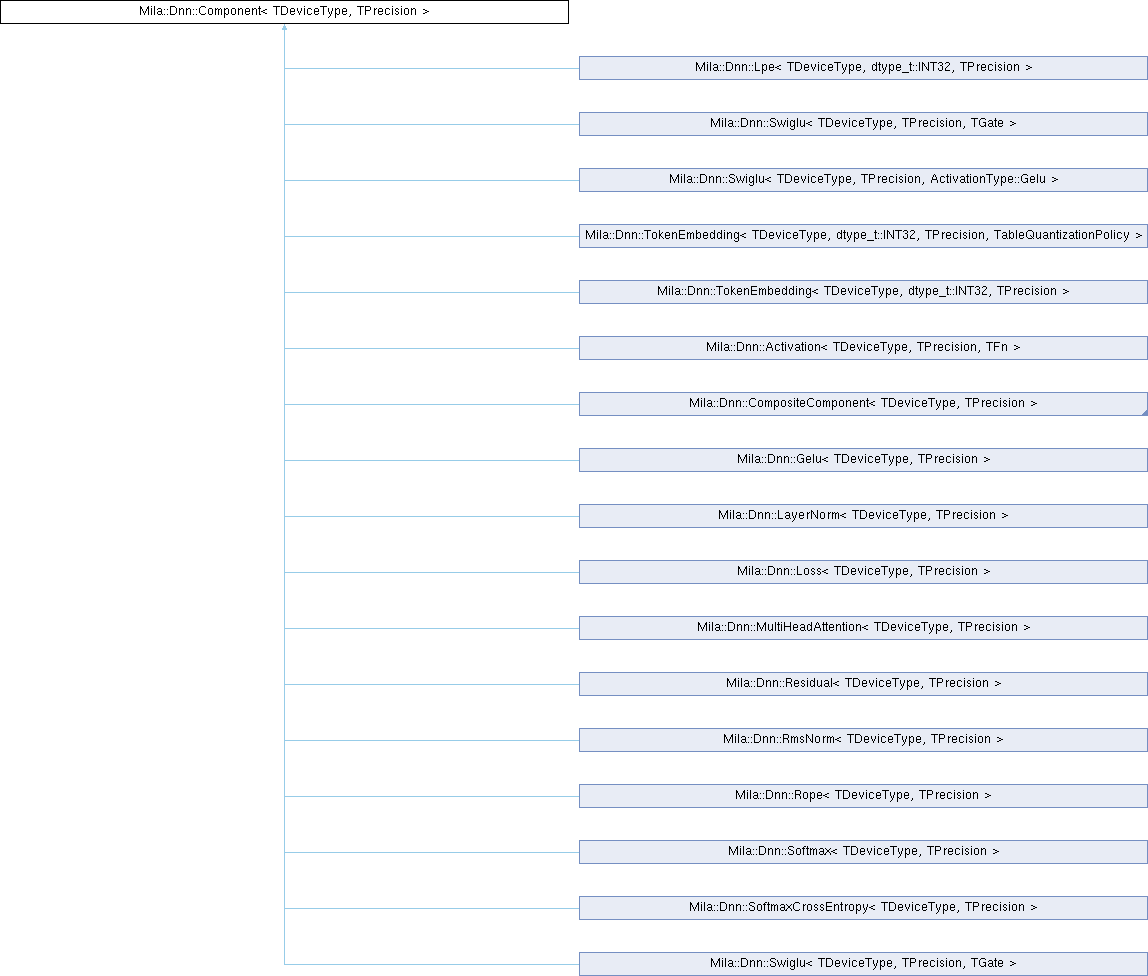
Inheritance diagram for Mila::Dnn::Component< TDeviceType, TPrecision >:
Public Member Functions | |
| Component (const std::string &name) | |
| Construct component with required name identifier. | |
| virtual void | build (const BuildContext &context) final |
| Build the component with the provided BuildContext (canonical overload). | |
| virtual DeviceId | getDeviceId () const =0 |
| Get the compute device id associated with this component. | |
| IExecutionContext * | getExecutionContext () const |
| Get the shared execution context. | |
| virtual std::vector< ITensor * > | getGradients () const =0 |
| Return non-owning pointers to parameter gradient tensors. | |
| virtual MemoryStats | getMemoryStats () const =0 |
| Return the current memory allocation breakdown for this component. | |
| const std::string | getName () const |
| Get the component's name identifier. | |
| virtual std::vector< ObservableStage > | getObservableStages () const |
| Stages this component publishes, and the passes each is published on. | |
| Compute::ComputePassMask | getObservedPasses () const noexcept |
| virtual std::vector< const ITensor * > | getOutputs () const |
| Return non-owning pointers to the tensors this component produces. | |
| virtual std::vector< std::string > | getParameterNames () const |
| List all available parameter names for this component. | |
| virtual std::vector< ITensor * > | getParameters () const =0 |
| Return non-owning pointers to parameter tensors. | |
| virtual MemoryStats | getRequiredMemory (const BuildContext &context) const |
| Report what build( context ) would allocate, without allocating it. | |
| RuntimeMode | getRuntimeMode () const noexcept |
| TrainingMode | getTrainingMode () const noexcept |
| The current runtime behavioral mode of this Component. | |
| virtual const ComponentType | getType () const =0 |
| Get the component type identifier. | |
| virtual bool | isBuilt () const final |
| Returns true if build() has completed successfully. | |
| bool | isInferenceMode () const noexcept |
| bool | isTrainingMode () const noexcept |
| virtual void | load_ (ModelArchive &archive, SerializationMode mode) |
| Restore this component's parameters from its archive scope. | |
| virtual void | loadParameter (const std::string &, const Serialization::ITensorBlob &) |
| Load a parameter from serialized tensor data. | |
| virtual dim_t | parameterCount () const =0 |
| Return number of trainable parameters. | |
| virtual void | requireSerializableParameters () const |
| Verify this component can serialize whatever parameters it owns. | |
| virtual void | save_ (ModelArchive &archive, SerializationMode mode) const =0 |
| virtual void | saveFlatTensors (Serialization::SafeTensorsWriter &writer, const std::string &prefix, Serialization::TensorSavePass pass) const |
| Drive this component's tensors through one pass of a flat safetensors save. | |
| void | setObservedPasses (Compute::ComputePassMask passes) noexcept |
| Select which passes this component publishes on. | |
| void | setTrainingMode (TrainingMode mode) |
| Set the runtime behavioral mode for this Component. | |
| virtual void | synchronize ()=0 |
| Wait for outstanding device work submitted by this component. | |
| virtual std::string | toString () const =0 |
| Produce a short, human-readable description of the component. | |
| virtual void | zeroGradients () |
| Clear all model-owned gradients for this component. | |
Static Public Member Functions | |
| static constexpr DeviceType | getDeviceType () |
| Compile-time device type for this component instance. | |
| static constexpr TensorDataType | getPrecision () noexcept |
| Compile-time tensor precision for this component instance. | |
Protected Types | |
| using | HostStagingMemoryResource = typename DeviceTypeTraits<TDeviceType>::host_staging_memory_resource |
| Host memory a device-resident parameter stages through. | |
Protected Member Functions | |
| bool | hasExecutionContext () const noexcept |
| Check if execution context has been set. | |
| template<TensorDataType TParameterPrecision, typename TMemoryResource> | |
| void | loadParameterFromBlob (const std::string ¶m_name, const Serialization::ITensorBlob &blob, Tensor< TParameterPrecision, TMemoryResource > &target, const shape_t &expected_shape) |
| Load a tensor blob into a parameter tensor with validation. | |
| virtual void | onBuilding (const BuildContext &) |
| Hook invoked by build() to allocate component buffers. | |
| virtual void | onExecutionContextSet () |
| Lifecycle hook: Called immediately after ExecutionContext is set. | |
| virtual void | onTrainingModeChanging (TrainingMode) |
| Hook called before TrainingMode transitions. | |
| void | publish (Compute::ComputePass pass, std::string_view stage, const ITensor &value) const |
| Publish one activation to the observer, if this pass is being observed. | |
| template<TensorDataType TParameterPrecision, typename TMemoryResource> | |
| void | saveParameterToArchive (ModelArchive &archive, const std::string ¶meter_name, const Tensor< TParameterPrecision, TMemoryResource > ¶meter) const |
| Write one parameter tensor into the archive under "tensors/<name>". | |
| template<TensorDataType TParameterPrecision, typename TMemoryResource> | |
| void | saveParameterToWriter (Serialization::SafeTensorsWriter &writer, const std::string &flat_name, const Tensor< TParameterPrecision, TMemoryResource > ¶meter, Serialization::TensorSavePass pass) const |
| Drive one parameter through one pass of a flat safetensors save. | |
| void | setExecutionContext (IExecutionContext *context) |
| Set the execution context for this component. | |
Protected Attributes | |
| BuildContext | build_context_ { shape_t{ 1 }, RuntimeMode::Training } |
| The BuildContext stored at build time. | |
Friends | |
| template<DeviceType, TensorDataType> | |
| class | CompositeComponent |
| template<DeviceType, TensorDataType> | |
| class | Network |
| std::ostream & | operator<< (std::ostream &os, const Component &component) |
| Stream output uses toString() to provide a human-readable description of the component. | |
Detailed Description
template<DeviceType TDeviceType, TensorDataType TPrecision>
requires PrecisionSupportedOnDevice<TPrecision, TDeviceType>
class Mila::Dnn::Component< TDeviceType, TPrecision >
requires PrecisionSupportedOnDevice<TPrecision, TDeviceType>
class Mila::Dnn::Component< TDeviceType, TPrecision >
Abstract base class for neural network components.
Component enforces a single ownership model: all components receive a non-owning pointer to an IExecutionContext that is owned by the parent (Network or test fixture). This ensures consistent resource sharing and eliminates dual constructor patterns.
Ownership model
- Components NEVER own ExecutionContext.
- Parent (Network/CompositeComponent) owns and provides shared context.
- Tests explicitly create context and pass raw pointer to components.
Component build lifecycle
Components progress through a well-defined lifecycle. Each stage has a single responsibility and a designated hook for subclass extension.
Stage 1 – Construction
The component is constructed with its name and component config. No device resources are allocated. No ExecutionContext is required.
auto linear = std::make_unique<Linear>( "fc", config, context );
Stage 2 – Build [ onBuilding() ]
build() is called with a BuildContext carrying the leading shape { B, T, ... } and the ExecutionMode that governs buffer allocation.
| Mode | allocationSeqLen() | Gradient buffers |
|---|---|---|
| Inference | 1 | never allocated |
| Training | leading_shape[1] | allocated on demand |
Allocated in onBuilding():
- output_ forward output buffer sized by allocationSeqLen()
- decode_output_ decode output buffer (decode-capable components)
- kv_cache_ KV cache (decode-capable components)
- operation_ buffers via operation_->build()
NOT allocated in onBuilding():
- gradient buffers (deferred to first setEvaluation( false ))
- backward state (deferred to first setEvaluation( false ))
The same BuildContext is cascaded unchanged through CompositeComponent and Network to all child components.
BuildContext config( shape_t{ batch_size, seq_length } );
config.withExecutionMode( ExecutionMode::Training );
model->build( config );
TensorShape shape_t
Row-major shape descriptor for tensor dimensional sizes.
Definition Tensor.Types.ixx:173
Build-time context for Component::build().
Definition Component.BuildContext.ixx:62
Stage 3 – Evaluation mode [ onEvaluationChanging() ]
Only valid for Training-built components. setEvaluation( false ) triggers gradient buffer allocation on the first call. Subsequent calls zero existing buffers without reallocating. setEvaluation( true ) zeros gradient buffers and disables the backward path.
Allocated on first setEvaluation( false ):
- input_grad_ input gradient buffer
- weight_grad_ weight gradient buffer
- bias_grad_ bias gradient buffer
model->setEvaluation( true ); // suspend backward -- eval checkpoint
generateSample( model );
model->setEvaluation( false ); // resume training
Stage 4 – Forward / Decode / Backward
Not declared on this class. Each concrete component declares its own compute methods with the arity its inputs need – Linear's forward( input ), Residual's forward( input_a, input_b ) – and decode-capable components add decode(). Those methods require build() to have completed, and backward() requires a component built for ExecutionMode::Training.
Runtime dimensions are read from the input tensor shape on each call. No shape information is cached from build time beyond what is in build_config_.
Lifecycle invariants
build() requires ExecutionContext to be set setEvaluation() requires build() to have completed setEvaluation() requires ExecutionMode::Training
Base class provides
- build() / lifecycle management with protected onBuilding() hook
- execution mode query: isInferenceMode(), isTrainingMode()
- evaluation mode transitions with serialized onEvaluationChanging() hook
- parameter and gradient access
- synchronization and serialization
- short human-readable diagnostics via toString()
- Template Parameters
-
TDeviceType Compile-time device identifier for this component. TPrecision Tensor data precision for this component.
- Trusted Collaborators
- This class grants private access to:
- CompositeComponent: Parent components that manage child execution contexts and aggregate parameters from child components.
- Network: Top-level graph coordinator that collects parameters and gradients for optimization and serialization.
Member Typedef Documentation
◆ HostStagingMemoryResource
template<DeviceType TDeviceType, TensorDataType TPrecision>
|
protected |
Host memory a device-resident parameter stages through.
Every serialization path here has to get device bytes somewhere the host can read them. Naming the CUDA pinned resource directly would put a CUDA import in an always-compiled core module, which a CPU-only build cannot satisfy – the backend axis belongs in DeviceTypeTraits, which is itself backend-gated.
Constructor & Destructor Documentation
◆ Component()
template<DeviceType TDeviceType, TensorDataType TPrecision>
|
inlineexplicit |
Construct component with required name identifier.
The name is used for identification, logging, and serialization. Names must be valid identifiers: start with a letter, contain only letters, digits, '.', '_', '-', and be 1-128 characters long.
- Parameters
-
name Component name identifier (mandatory).
- Exceptions
-
std::invalid_argument if name is not a valid identifier.
Member Function Documentation
◆ build()
template<DeviceType TDeviceType, TensorDataType TPrecision>
|
inlinefinalvirtual |
Build the component with the provided BuildContext (canonical overload).
Validates the config, stores it as build_config_, then invokes the onBuilding() hook for component-specific buffer allocation and initialization.
After onBuilding() returns without throwing, the component is marked built and isBuilt() returns true. If onBuilding() throws, built_ remains false and build() may be retried – but only if the onBuilding() implementation leaves component state coherent on failure.
The stored BuildContext is accessible to derived classes via the protected build_config_ member throughout the component lifetime.
- Parameters
-
context Build-time configuration carrying the leading shape { B, T, ... }, ExecutionMode, and optional micro-batching settings.
- Exceptions
-
std::runtime_error if the component is already built. std::runtime_error if no ExecutionContext has been set. std::invalid_argument if config.validate() fails. Any exception from onBuilding().
◆ getDeviceId()
template<DeviceType TDeviceType, TensorDataType TPrecision>
|
pure virtual |
Get the compute device id associated with this component.
Must return the device on which parameters and operations execute.
Implemented in Mila::Dnn::Activation< TDeviceType, TPrecision, TFn >, Mila::Dnn::Activation< TDeviceType, TPrecision, ActivationType::Silu >, Mila::Dnn::AttentionOutputGate< TDeviceType, TPrecision, TGate >, Mila::Dnn::AttentionOutputGate< TDeviceType, TPrecision, ActivationType::Sigmoid >, Mila::Dnn::AttentionOutputGate< TDeviceType, TPrecision, ActivationType::Silu >, Mila::Dnn::CausalConv1d< TDeviceType, TPrecision >, Mila::Dnn::CompositeComponent< TDeviceType, TPrecision >, Mila::Dnn::GatedDeltaRule< TDeviceType, TPrecision >, Mila::Dnn::Gelu< TDeviceType, TPrecision >, Mila::Dnn::GroupedQueryAttention< TDeviceType, TComputePrecision, TKvPolicy >, Mila::Dnn::GroupedQueryAttention< TDeviceType, TPrecision, TKvPolicy >, Mila::Dnn::LayerNorm< TDeviceType, TPrecision >, Mila::Dnn::Linear< TDeviceType, TComputePrecision, TWeightQuant >, Mila::Dnn::Linear< TDeviceType, TPrecision >, Mila::Dnn::Linear< TDeviceType, TPrecision, TableQuantizationPolicy >, Mila::Dnn::Linear< TDeviceType, TPrecision, TWeightQuant >, Mila::Dnn::Linear< TDeviceType, TPrecision, TWeightQuantization >, Mila::Dnn::Linear< TDeviceType, TPrecision, typename PrecisionPlan::DeltaNetGating >, Mila::Dnn::Linear< TDeviceType, TPrecision, typename PrecisionPlan::DeltaNetQueryKey >, Mila::Dnn::Linear< TDeviceType, TPrecision, typename PrecisionPlan::DeltaNetValueGateOutput >, Mila::Dnn::Linear< TDeviceType, TPrecision, typename PrecisionPlan::FeedForwardDown >, Mila::Dnn::Linear< TDeviceType, TPrecision, typename PrecisionPlan::FeedForwardGateUp >, Mila::Dnn::Linear< TDeviceType, TPrecision, typename PrecisionPlan::LanguageModelHead >, Mila::Dnn::Linear< TDeviceType, TPrecision, typename PrecisionPlan::OutputProjection >, Mila::Dnn::Linear< TDeviceType, TPrecision, typename PrecisionPlan::QkvProjection >, Mila::Dnn::Lpe< TDeviceType, TIndex, TPrecision >, Mila::Dnn::Lpe< TDeviceType, dtype_t::INT32, TPrecision >, Mila::Dnn::MixtureOfExperts< TDeviceType, TPrecision, TGate, TWeightQuantization >, Mila::Dnn::MixtureOfExperts< TDeviceType, TPrecision, ActivationType::Gelu, TWeightQuant >, Mila::Dnn::MultiHeadAttention< TDeviceType, TPrecision >, Mila::Dnn::Network< TDeviceType, TPrecision >, Mila::Dnn::Residual< TDeviceType, TPrecision >, Mila::Dnn::RmsNorm< TDeviceType, TPrecision >, Mila::Dnn::Rope< TDeviceType, TPrecision >, Mila::Dnn::Softmax< TDeviceType, TPrecision >, Mila::Dnn::SoftmaxCrossEntropy< TDeviceType, TPrecision >, Mila::Dnn::Swiglu< TDeviceType, TPrecision, TGate >, Mila::Dnn::Swiglu< TDeviceType, TPrecision, ActivationType::Gelu >, Mila::Dnn::Swiglu< TDeviceType, TPrecision, ActivationType::Silu >, Mila::Dnn::Swiglu< TDeviceType, TPrecision, TGate >, Mila::Dnn::TokenEmbedding< TDeviceType, TIndex, TPrecision, TTableQuantization, TTableResidency >, Mila::Dnn::TokenEmbedding< TDeviceType, dtype_t::INT32, TPrecision >, Mila::Dnn::TokenEmbedding< TDeviceType, dtype_t::INT32, TPrecision, TableQuantizationPolicy >, and Mila::Dnn::TokenEmbedding< TDeviceType, dtype_t::INT32, TPrecision, typename PrecisionPlan::EmbeddingTable, kEmbeddingTableResidency >.
◆ getExecutionContext()
template<DeviceType TDeviceType, TensorDataType TPrecision>
|
inline |
Get the shared execution context.
Public because the context is the seam through which a caller reaches capabilities the component itself does not re-expose: constructing model-level orchestrator tools on the network's context (TokenSampler), and installing an activation observer (see IExecutionContext::setActivationObserver). Derived classes use it to query device information, create tensors on the correct device, pass it to backend operations, and synchronize device work.
- Returns
- Non-owning pointer to execution context (guaranteed non-null).
- Exceptions
-
std::runtime_error if context has not been set.
◆ getGradients()
template<DeviceType TDeviceType, TensorDataType TPrecision>
|
pure virtual |
Return non-owning pointers to parameter gradient tensors.
Gradient buffers are allocated only when the component is built in training mode, so a component built for inference returns an empty vector. Stateless components return empty in either mode. This is the accessor counterpart to getParameters() and does not throw on mode.
- Returns
- Vector of gradient pointers; empty when built for inference.
- Exceptions
-
std::runtime_error if called before the component has been built.
Implemented in Mila::Dnn::Activation< TDeviceType, TPrecision, TFn >, Mila::Dnn::Activation< TDeviceType, TPrecision, ActivationType::Silu >, Mila::Dnn::AttentionOutputGate< TDeviceType, TPrecision, TGate >, Mila::Dnn::AttentionOutputGate< TDeviceType, TPrecision, ActivationType::Sigmoid >, Mila::Dnn::AttentionOutputGate< TDeviceType, TPrecision, ActivationType::Silu >, Mila::Dnn::CausalConv1d< TDeviceType, TPrecision >, Mila::Dnn::CompositeComponent< TDeviceType, TPrecision >, Mila::Dnn::GatedDeltaRule< TDeviceType, TPrecision >, Mila::Dnn::Gelu< TDeviceType, TPrecision >, Mila::Dnn::GroupedQueryAttention< TDeviceType, TComputePrecision, TKvPolicy >, Mila::Dnn::GroupedQueryAttention< TDeviceType, TPrecision, TKvPolicy >, Mila::Dnn::LayerNorm< TDeviceType, TPrecision >, Mila::Dnn::Linear< TDeviceType, TComputePrecision, TWeightQuant >, Mila::Dnn::Linear< TDeviceType, TPrecision >, Mila::Dnn::Linear< TDeviceType, TPrecision, TableQuantizationPolicy >, Mila::Dnn::Linear< TDeviceType, TPrecision, TWeightQuant >, Mila::Dnn::Linear< TDeviceType, TPrecision, TWeightQuantization >, Mila::Dnn::Linear< TDeviceType, TPrecision, typename PrecisionPlan::DeltaNetGating >, Mila::Dnn::Linear< TDeviceType, TPrecision, typename PrecisionPlan::DeltaNetQueryKey >, Mila::Dnn::Linear< TDeviceType, TPrecision, typename PrecisionPlan::DeltaNetValueGateOutput >, Mila::Dnn::Linear< TDeviceType, TPrecision, typename PrecisionPlan::FeedForwardDown >, Mila::Dnn::Linear< TDeviceType, TPrecision, typename PrecisionPlan::FeedForwardGateUp >, Mila::Dnn::Linear< TDeviceType, TPrecision, typename PrecisionPlan::LanguageModelHead >, Mila::Dnn::Linear< TDeviceType, TPrecision, typename PrecisionPlan::OutputProjection >, Mila::Dnn::Linear< TDeviceType, TPrecision, typename PrecisionPlan::QkvProjection >, Mila::Dnn::Lpe< TDeviceType, TIndex, TPrecision >, Mila::Dnn::Lpe< TDeviceType, dtype_t::INT32, TPrecision >, Mila::Dnn::MixtureOfExperts< TDeviceType, TPrecision, TGate, TWeightQuantization >, Mila::Dnn::MixtureOfExperts< TDeviceType, TPrecision, ActivationType::Gelu, TWeightQuant >, Mila::Dnn::MultiHeadAttention< TDeviceType, TPrecision >, Mila::Dnn::Residual< TDeviceType, TPrecision >, Mila::Dnn::RmsNorm< TDeviceType, TPrecision >, Mila::Dnn::Rope< TDeviceType, TPrecision >, Mila::Dnn::Softmax< TDeviceType, TPrecision >, Mila::Dnn::SoftmaxCrossEntropy< TDeviceType, TPrecision >, Mila::Dnn::Swiglu< TDeviceType, TPrecision, TGate >, Mila::Dnn::Swiglu< TDeviceType, TPrecision, ActivationType::Gelu >, Mila::Dnn::Swiglu< TDeviceType, TPrecision, ActivationType::Silu >, Mila::Dnn::Swiglu< TDeviceType, TPrecision, TGate >, Mila::Dnn::TokenEmbedding< TDeviceType, TIndex, TPrecision, TTableQuantization, TTableResidency >, Mila::Dnn::TokenEmbedding< TDeviceType, dtype_t::INT32, TPrecision >, Mila::Dnn::TokenEmbedding< TDeviceType, dtype_t::INT32, TPrecision, TableQuantizationPolicy >, and Mila::Dnn::TokenEmbedding< TDeviceType, dtype_t::INT32, TPrecision, typename PrecisionPlan::EmbeddingTable, kEmbeddingTableResidency >.
◆ getMemoryStats()
template<DeviceType TDeviceType, TensorDataType TPrecision>
|
pure virtual |
Return the current memory allocation breakdown for this component.
Reflects allocations at the moment of the call. The returned stats naturally track the component lifecycle:
After construction – nothing; construction allocates none After build( Inference ) – parameters + T=1 state buffers After build( Training ) – parameters + T=full state buffers After setTrainingMode( Train ) – parameters + state + gradients
For CompositeComponent and Network, the returned stats are the recursive aggregate of all child components.
May be called at any time – no lifecycle preconditions.
- Returns
- MemoryStats reflecting current allocations.
Implemented in Mila::Dnn::Activation< TDeviceType, TPrecision, TFn >, Mila::Dnn::Activation< TDeviceType, TPrecision, ActivationType::Silu >, Mila::Dnn::AttentionOutputGate< TDeviceType, TPrecision, TGate >, Mila::Dnn::AttentionOutputGate< TDeviceType, TPrecision, ActivationType::Sigmoid >, Mila::Dnn::AttentionOutputGate< TDeviceType, TPrecision, ActivationType::Silu >, Mila::Dnn::CausalConv1d< TDeviceType, TPrecision >, Mila::Dnn::GatedDeltaRule< TDeviceType, TPrecision >, Mila::Dnn::GatedMLP< TDeviceType, TPrecision, TGate, TWeightQuantization >, Mila::Dnn::GatedMLP< TDeviceType, TPrecision, ActivationType::Gelu, TWeightQuant >, Mila::Dnn::Gelu< TDeviceType, TPrecision >, Mila::Dnn::GemmaBlock< TDeviceType, TPrecision, kGlobal, TWeightQuant, TKvPolicy, kDelegatedFeedForward, kMixtureOfExperts >, Mila::Dnn::GemmaBlock< TDeviceType, TPrecision, false, TWeightQuantization, TKvCachePolicy, kDelegatedFeedForward, kMixtureOfExperts >, Mila::Dnn::GemmaBlock< TDeviceType, TPrecision, true, TWeightQuantization, NoKvCompression, kDelegatedFeedForward, kMixtureOfExperts >, Mila::Dnn::GemmaTransformer< TDeviceType, TPrecision, TWeightQuantization, TKvCachePolicy, kDelegatedFeedForward, kMixtureOfExperts >, Mila::Dnn::GptBlock< TDeviceType, TPrecision >, Mila::Dnn::GptTransformer< TDeviceType, TPrecision >, Mila::Dnn::GroupedQueryAttention< TDeviceType, TComputePrecision, TKvPolicy >, Mila::Dnn::GroupedQueryAttention< TDeviceType, TPrecision, TKvPolicy >, Mila::Dnn::LayerNorm< TDeviceType, TPrecision >, Mila::Dnn::Linear< TDeviceType, TComputePrecision, TWeightQuant >, Mila::Dnn::Linear< TDeviceType, TPrecision >, Mila::Dnn::Linear< TDeviceType, TPrecision, TableQuantizationPolicy >, Mila::Dnn::Linear< TDeviceType, TPrecision, TWeightQuant >, Mila::Dnn::Linear< TDeviceType, TPrecision, TWeightQuantization >, Mila::Dnn::Linear< TDeviceType, TPrecision, typename PrecisionPlan::DeltaNetGating >, Mila::Dnn::Linear< TDeviceType, TPrecision, typename PrecisionPlan::DeltaNetQueryKey >, Mila::Dnn::Linear< TDeviceType, TPrecision, typename PrecisionPlan::DeltaNetValueGateOutput >, Mila::Dnn::Linear< TDeviceType, TPrecision, typename PrecisionPlan::FeedForwardDown >, Mila::Dnn::Linear< TDeviceType, TPrecision, typename PrecisionPlan::FeedForwardGateUp >, Mila::Dnn::Linear< TDeviceType, TPrecision, typename PrecisionPlan::LanguageModelHead >, Mila::Dnn::Linear< TDeviceType, TPrecision, typename PrecisionPlan::OutputProjection >, Mila::Dnn::Linear< TDeviceType, TPrecision, typename PrecisionPlan::QkvProjection >, Mila::Dnn::LlamaBlock< TDeviceType, TPrecision, TWeightQuant, TKvPolicy >, Mila::Dnn::LlamaBlock< TDeviceType, TPrecision, TWeightQuantization, TKvCachePolicy >, Mila::Dnn::LlamaTransformer< TDeviceType, TPrecision, TWeightQuantization, TKvCachePolicy >, Mila::Dnn::Lpe< TDeviceType, TIndex, TPrecision >, Mila::Dnn::Lpe< TDeviceType, dtype_t::INT32, TPrecision >, Mila::Dnn::MixtureOfExperts< TDeviceType, TPrecision, TGate, TWeightQuantization >, Mila::Dnn::MixtureOfExperts< TDeviceType, TPrecision, ActivationType::Gelu, TWeightQuant >, Mila::Dnn::MLP< TDeviceType, TPrecision >, Mila::Dnn::MultiHeadAttention< TDeviceType, TPrecision >, Mila::Dnn::QwenAttentionBlock< TDeviceType, TPrecision, TWeightPlan, TKvPolicy >, Mila::Dnn::QwenAttentionBlock< TDeviceType, TPrecision, TWeightPlan, TKvCachePolicy >, Mila::Dnn::QwenDeltaNetBlock< TDeviceType, TPrecision, TWeightPlan >, Mila::Dnn::QwenDeltaNetBlock< TDeviceType, TPrecision, TWeightPlan >, Mila::Dnn::QwenTransformer< TDeviceType, TPrecision, TWeightPlan, TKvCachePolicy >, Mila::Dnn::Residual< TDeviceType, TPrecision >, Mila::Dnn::RmsNorm< TDeviceType, TPrecision >, Mila::Dnn::Rope< TDeviceType, TPrecision >, Mila::Dnn::Router< TDeviceType, TPrecision >, Mila::Dnn::Softmax< TDeviceType, TPrecision >, Mila::Dnn::Swiglu< TDeviceType, TPrecision, TGate >, Mila::Dnn::Swiglu< TDeviceType, TPrecision, ActivationType::Gelu >, Mila::Dnn::Swiglu< TDeviceType, TPrecision, ActivationType::Silu >, Mila::Dnn::Swiglu< TDeviceType, TPrecision, TGate >, Mila::Dnn::TokenEmbedding< TDeviceType, TIndex, TPrecision, TTableQuantization, TTableResidency >, Mila::Dnn::TokenEmbedding< TDeviceType, dtype_t::INT32, TPrecision >, Mila::Dnn::TokenEmbedding< TDeviceType, dtype_t::INT32, TPrecision, TableQuantizationPolicy >, and Mila::Dnn::TokenEmbedding< TDeviceType, dtype_t::INT32, TPrecision, typename PrecisionPlan::EmbeddingTable, kEmbeddingTableResidency >.
◆ getName()
template<DeviceType TDeviceType, TensorDataType TPrecision>
|
inline |
Get the component's name identifier.
The name is used for logging, diagnostics, and serialization.
- Returns
- Component full hierarchical path.
◆ getObservableStages()
template<DeviceType TDeviceType, TensorDataType TPrecision>
|
inlinevirtual |
Stages this component publishes, and the passes each is published on.
Lets a caller tell an uninstrumented component from a clean one before running anything. The pass qualifier is load-bearing rather than decorative: the stage set genuinely differs by pass, since a prefill can produce intermediates its decode never materializes.
- Returns
- Vector of stages; empty for components that publish nothing.
Reimplemented in Mila::Dnn::Activation< TDeviceType, TPrecision, TFn >, Mila::Dnn::Activation< TDeviceType, TPrecision, ActivationType::Silu >, Mila::Dnn::AttentionOutputGate< TDeviceType, TPrecision, TGate >, Mila::Dnn::AttentionOutputGate< TDeviceType, TPrecision, ActivationType::Sigmoid >, Mila::Dnn::AttentionOutputGate< TDeviceType, TPrecision, ActivationType::Silu >, Mila::Dnn::CausalConv1d< TDeviceType, TPrecision >, Mila::Dnn::GatedDeltaRule< TDeviceType, TPrecision >, Mila::Dnn::GatedMLP< TDeviceType, TPrecision, TGate, TWeightQuantization >, Mila::Dnn::GatedMLP< TDeviceType, TPrecision, ActivationType::Gelu, TWeightQuant >, Mila::Dnn::Gelu< TDeviceType, TPrecision >, Mila::Dnn::GemmaBlock< TDeviceType, TPrecision, kGlobal, TWeightQuant, TKvPolicy, kDelegatedFeedForward, kMixtureOfExperts >, Mila::Dnn::GemmaBlock< TDeviceType, TPrecision, false, TWeightQuantization, TKvCachePolicy, kDelegatedFeedForward, kMixtureOfExperts >, Mila::Dnn::GemmaBlock< TDeviceType, TPrecision, true, TWeightQuantization, NoKvCompression, kDelegatedFeedForward, kMixtureOfExperts >, Mila::Dnn::GptBlock< TDeviceType, TPrecision >, Mila::Dnn::GroupedQueryAttention< TDeviceType, TComputePrecision, TKvPolicy >, Mila::Dnn::GroupedQueryAttention< TDeviceType, TPrecision, TKvPolicy >, Mila::Dnn::LayerNorm< TDeviceType, TPrecision >, Mila::Dnn::Linear< TDeviceType, TComputePrecision, TWeightQuant >, Mila::Dnn::Linear< TDeviceType, TPrecision >, Mila::Dnn::Linear< TDeviceType, TPrecision, TableQuantizationPolicy >, Mila::Dnn::Linear< TDeviceType, TPrecision, TWeightQuant >, Mila::Dnn::Linear< TDeviceType, TPrecision, TWeightQuantization >, Mila::Dnn::Linear< TDeviceType, TPrecision, typename PrecisionPlan::DeltaNetGating >, Mila::Dnn::Linear< TDeviceType, TPrecision, typename PrecisionPlan::DeltaNetQueryKey >, Mila::Dnn::Linear< TDeviceType, TPrecision, typename PrecisionPlan::DeltaNetValueGateOutput >, Mila::Dnn::Linear< TDeviceType, TPrecision, typename PrecisionPlan::FeedForwardDown >, Mila::Dnn::Linear< TDeviceType, TPrecision, typename PrecisionPlan::FeedForwardGateUp >, Mila::Dnn::Linear< TDeviceType, TPrecision, typename PrecisionPlan::LanguageModelHead >, Mila::Dnn::Linear< TDeviceType, TPrecision, typename PrecisionPlan::OutputProjection >, Mila::Dnn::Linear< TDeviceType, TPrecision, typename PrecisionPlan::QkvProjection >, Mila::Dnn::LlamaBlock< TDeviceType, TPrecision, TWeightQuant, TKvPolicy >, Mila::Dnn::LlamaBlock< TDeviceType, TPrecision, TWeightQuantization, TKvCachePolicy >, Mila::Dnn::Lpe< TDeviceType, TIndex, TPrecision >, Mila::Dnn::Lpe< TDeviceType, dtype_t::INT32, TPrecision >, Mila::Dnn::MixtureOfExperts< TDeviceType, TPrecision, TGate, TWeightQuantization >, Mila::Dnn::MixtureOfExperts< TDeviceType, TPrecision, ActivationType::Gelu, TWeightQuant >, Mila::Dnn::MLP< TDeviceType, TPrecision >, Mila::Dnn::MultiHeadAttention< TDeviceType, TPrecision >, Mila::Dnn::QwenAttentionBlock< TDeviceType, TPrecision, TWeightPlan, TKvPolicy >, Mila::Dnn::QwenAttentionBlock< TDeviceType, TPrecision, TWeightPlan, TKvCachePolicy >, Mila::Dnn::QwenDeltaNetBlock< TDeviceType, TPrecision, TWeightPlan >, Mila::Dnn::QwenDeltaNetBlock< TDeviceType, TPrecision, TWeightPlan >, Mila::Dnn::Residual< TDeviceType, TPrecision >, Mila::Dnn::RmsNorm< TDeviceType, TPrecision >, Mila::Dnn::Rope< TDeviceType, TPrecision >, Mila::Dnn::Router< TDeviceType, TPrecision >, Mila::Dnn::Softmax< TDeviceType, TPrecision >, Mila::Dnn::TokenEmbedding< TDeviceType, TIndex, TPrecision, TTableQuantization, TTableResidency >, Mila::Dnn::TokenEmbedding< TDeviceType, dtype_t::INT32, TPrecision >, Mila::Dnn::TokenEmbedding< TDeviceType, dtype_t::INT32, TPrecision, TableQuantizationPolicy >, and Mila::Dnn::TokenEmbedding< TDeviceType, dtype_t::INT32, TPrecision, typename PrecisionPlan::EmbeddingTable, kEmbeddingTableResidency >.
◆ getOutputs()
template<DeviceType TDeviceType, TensorDataType TPrecision>
|
inlinevirtual |
Return non-owning pointers to the tensors this component produces.
The counterpart to getParameters(): that reports what a component HOLDS, this reports what it PRODUCES. Tensors are the built allocations, so their extents are the ceiling a forward pass may narrow within – an observer wanting the live value of a particular call receives it through publication instead.
An empty result means the component does not describe itself. That absence cannot be mistaken for a finding – a view renders no row for it – so no distinction beyond empty is offered.
- Returns
- Vector of output pointers; empty before build, and for undescribed components.
Reimplemented in Mila::Dnn::Activation< TDeviceType, TPrecision, TFn >, Mila::Dnn::Activation< TDeviceType, TPrecision, ActivationType::Silu >, Mila::Dnn::AttentionOutputGate< TDeviceType, TPrecision, TGate >, Mila::Dnn::AttentionOutputGate< TDeviceType, TPrecision, ActivationType::Sigmoid >, Mila::Dnn::AttentionOutputGate< TDeviceType, TPrecision, ActivationType::Silu >, Mila::Dnn::CausalConv1d< TDeviceType, TPrecision >, Mila::Dnn::GatedDeltaRule< TDeviceType, TPrecision >, Mila::Dnn::Gelu< TDeviceType, TPrecision >, Mila::Dnn::GroupedQueryAttention< TDeviceType, TComputePrecision, TKvPolicy >, Mila::Dnn::GroupedQueryAttention< TDeviceType, TPrecision, TKvPolicy >, Mila::Dnn::LayerNorm< TDeviceType, TPrecision >, Mila::Dnn::Linear< TDeviceType, TComputePrecision, TWeightQuant >, Mila::Dnn::Linear< TDeviceType, TPrecision >, Mila::Dnn::Linear< TDeviceType, TPrecision, TableQuantizationPolicy >, Mila::Dnn::Linear< TDeviceType, TPrecision, TWeightQuant >, Mila::Dnn::Linear< TDeviceType, TPrecision, TWeightQuantization >, Mila::Dnn::Linear< TDeviceType, TPrecision, typename PrecisionPlan::DeltaNetGating >, Mila::Dnn::Linear< TDeviceType, TPrecision, typename PrecisionPlan::DeltaNetQueryKey >, Mila::Dnn::Linear< TDeviceType, TPrecision, typename PrecisionPlan::DeltaNetValueGateOutput >, Mila::Dnn::Linear< TDeviceType, TPrecision, typename PrecisionPlan::FeedForwardDown >, Mila::Dnn::Linear< TDeviceType, TPrecision, typename PrecisionPlan::FeedForwardGateUp >, Mila::Dnn::Linear< TDeviceType, TPrecision, typename PrecisionPlan::LanguageModelHead >, Mila::Dnn::Linear< TDeviceType, TPrecision, typename PrecisionPlan::OutputProjection >, Mila::Dnn::Linear< TDeviceType, TPrecision, typename PrecisionPlan::QkvProjection >, Mila::Dnn::Lpe< TDeviceType, TIndex, TPrecision >, Mila::Dnn::Lpe< TDeviceType, dtype_t::INT32, TPrecision >, Mila::Dnn::MultiHeadAttention< TDeviceType, TPrecision >, Mila::Dnn::Residual< TDeviceType, TPrecision >, Mila::Dnn::RmsNorm< TDeviceType, TPrecision >, Mila::Dnn::TokenEmbedding< TDeviceType, TIndex, TPrecision, TTableQuantization, TTableResidency >, Mila::Dnn::TokenEmbedding< TDeviceType, dtype_t::INT32, TPrecision >, Mila::Dnn::TokenEmbedding< TDeviceType, dtype_t::INT32, TPrecision, TableQuantizationPolicy >, and Mila::Dnn::TokenEmbedding< TDeviceType, dtype_t::INT32, TPrecision, typename PrecisionPlan::EmbeddingTable, kEmbeddingTableResidency >.
◆ getParameterNames()
template<DeviceType TDeviceType, TensorDataType TPrecision>
|
inlinevirtual |
List all available parameter names for this component.
Returns an empty vector by default. Leaf components with parameters should override to return their canonical parameter name list in the same stable order used by save_() and loadParameter().
Reimplemented in Mila::Dnn::CausalConv1d< TDeviceType, TPrecision >, Mila::Dnn::GatedDeltaRule< TDeviceType, TPrecision >, Mila::Dnn::GemmaBlock< TDeviceType, TPrecision, kGlobal, TWeightQuant, TKvPolicy, kDelegatedFeedForward, kMixtureOfExperts >, Mila::Dnn::GemmaBlock< TDeviceType, TPrecision, false, TWeightQuantization, TKvCachePolicy, kDelegatedFeedForward, kMixtureOfExperts >, Mila::Dnn::GemmaBlock< TDeviceType, TPrecision, true, TWeightQuantization, NoKvCompression, kDelegatedFeedForward, kMixtureOfExperts >, Mila::Dnn::LayerNorm< TDeviceType, TPrecision >, Mila::Dnn::Linear< TDeviceType, TComputePrecision, TWeightQuant >, Mila::Dnn::Linear< TDeviceType, TPrecision >, Mila::Dnn::Linear< TDeviceType, TPrecision, TableQuantizationPolicy >, Mila::Dnn::Linear< TDeviceType, TPrecision, TWeightQuant >, Mila::Dnn::Linear< TDeviceType, TPrecision, TWeightQuantization >, Mila::Dnn::Linear< TDeviceType, TPrecision, typename PrecisionPlan::DeltaNetGating >, Mila::Dnn::Linear< TDeviceType, TPrecision, typename PrecisionPlan::DeltaNetQueryKey >, Mila::Dnn::Linear< TDeviceType, TPrecision, typename PrecisionPlan::DeltaNetValueGateOutput >, Mila::Dnn::Linear< TDeviceType, TPrecision, typename PrecisionPlan::FeedForwardDown >, Mila::Dnn::Linear< TDeviceType, TPrecision, typename PrecisionPlan::FeedForwardGateUp >, Mila::Dnn::Linear< TDeviceType, TPrecision, typename PrecisionPlan::LanguageModelHead >, Mila::Dnn::Linear< TDeviceType, TPrecision, typename PrecisionPlan::OutputProjection >, Mila::Dnn::Linear< TDeviceType, TPrecision, typename PrecisionPlan::QkvProjection >, Mila::Dnn::Lpe< TDeviceType, TIndex, TPrecision >, Mila::Dnn::Lpe< TDeviceType, dtype_t::INT32, TPrecision >, Mila::Dnn::MixtureOfExperts< TDeviceType, TPrecision, TGate, TWeightQuantization >, Mila::Dnn::MixtureOfExperts< TDeviceType, TPrecision, ActivationType::Gelu, TWeightQuant >, Mila::Dnn::RmsNorm< TDeviceType, TPrecision >, Mila::Dnn::Router< TDeviceType, TPrecision >, Mila::Dnn::TokenEmbedding< TDeviceType, TIndex, TPrecision, TTableQuantization, TTableResidency >, Mila::Dnn::TokenEmbedding< TDeviceType, dtype_t::INT32, TPrecision >, Mila::Dnn::TokenEmbedding< TDeviceType, dtype_t::INT32, TPrecision, TableQuantizationPolicy >, and Mila::Dnn::TokenEmbedding< TDeviceType, dtype_t::INT32, TPrecision, typename PrecisionPlan::EmbeddingTable, kEmbeddingTableResidency >.
◆ getParameters()
template<DeviceType TDeviceType, TensorDataType TPrecision>
|
pure virtual |
Return non-owning pointers to parameter tensors.
The returned tensor pointers remain valid for the lifetime of the component. Order should be canonical (weights before biases).
Implemented in Mila::Dnn::Activation< TDeviceType, TPrecision, TFn >, Mila::Dnn::Activation< TDeviceType, TPrecision, ActivationType::Silu >, Mila::Dnn::AttentionOutputGate< TDeviceType, TPrecision, TGate >, Mila::Dnn::AttentionOutputGate< TDeviceType, TPrecision, ActivationType::Sigmoid >, Mila::Dnn::AttentionOutputGate< TDeviceType, TPrecision, ActivationType::Silu >, Mila::Dnn::CausalConv1d< TDeviceType, TPrecision >, Mila::Dnn::CompositeComponent< TDeviceType, TPrecision >, Mila::Dnn::GatedDeltaRule< TDeviceType, TPrecision >, Mila::Dnn::Gelu< TDeviceType, TPrecision >, Mila::Dnn::GroupedQueryAttention< TDeviceType, TComputePrecision, TKvPolicy >, Mila::Dnn::GroupedQueryAttention< TDeviceType, TPrecision, TKvPolicy >, Mila::Dnn::LayerNorm< TDeviceType, TPrecision >, Mila::Dnn::Linear< TDeviceType, TComputePrecision, TWeightQuant >, Mila::Dnn::Linear< TDeviceType, TPrecision >, Mila::Dnn::Linear< TDeviceType, TPrecision, TableQuantizationPolicy >, Mila::Dnn::Linear< TDeviceType, TPrecision, TWeightQuant >, Mila::Dnn::Linear< TDeviceType, TPrecision, TWeightQuantization >, Mila::Dnn::Linear< TDeviceType, TPrecision, typename PrecisionPlan::DeltaNetGating >, Mila::Dnn::Linear< TDeviceType, TPrecision, typename PrecisionPlan::DeltaNetQueryKey >, Mila::Dnn::Linear< TDeviceType, TPrecision, typename PrecisionPlan::DeltaNetValueGateOutput >, Mila::Dnn::Linear< TDeviceType, TPrecision, typename PrecisionPlan::FeedForwardDown >, Mila::Dnn::Linear< TDeviceType, TPrecision, typename PrecisionPlan::FeedForwardGateUp >, Mila::Dnn::Linear< TDeviceType, TPrecision, typename PrecisionPlan::LanguageModelHead >, Mila::Dnn::Linear< TDeviceType, TPrecision, typename PrecisionPlan::OutputProjection >, Mila::Dnn::Linear< TDeviceType, TPrecision, typename PrecisionPlan::QkvProjection >, Mila::Dnn::Lpe< TDeviceType, TIndex, TPrecision >, Mila::Dnn::Lpe< TDeviceType, dtype_t::INT32, TPrecision >, Mila::Dnn::MixtureOfExperts< TDeviceType, TPrecision, TGate, TWeightQuantization >, Mila::Dnn::MixtureOfExperts< TDeviceType, TPrecision, ActivationType::Gelu, TWeightQuant >, Mila::Dnn::MultiHeadAttention< TDeviceType, TPrecision >, Mila::Dnn::Residual< TDeviceType, TPrecision >, Mila::Dnn::RmsNorm< TDeviceType, TPrecision >, Mila::Dnn::Rope< TDeviceType, TPrecision >, Mila::Dnn::Softmax< TDeviceType, TPrecision >, Mila::Dnn::SoftmaxCrossEntropy< TDeviceType, TPrecision >, Mila::Dnn::Swiglu< TDeviceType, TPrecision, TGate >, Mila::Dnn::Swiglu< TDeviceType, TPrecision, ActivationType::Gelu >, Mila::Dnn::Swiglu< TDeviceType, TPrecision, ActivationType::Silu >, Mila::Dnn::Swiglu< TDeviceType, TPrecision, TGate >, Mila::Dnn::TokenEmbedding< TDeviceType, TIndex, TPrecision, TTableQuantization, TTableResidency >, Mila::Dnn::TokenEmbedding< TDeviceType, dtype_t::INT32, TPrecision >, Mila::Dnn::TokenEmbedding< TDeviceType, dtype_t::INT32, TPrecision, TableQuantizationPolicy >, and Mila::Dnn::TokenEmbedding< TDeviceType, dtype_t::INT32, TPrecision, typename PrecisionPlan::EmbeddingTable, kEmbeddingTableResidency >.
◆ getRequiredMemory()
template<DeviceType TDeviceType, TensorDataType TPrecision>
|
inlinevirtual |
Report what build( context ) would allocate, without allocating it.
The predictive counterpart to getMemoryStats(): what this component would need against what it currently has. Called on a constructed but unbuilt component, which is possible because construction commits no device memory – see Specifications/MemoryFootprint.md.
Implementations mirror their own onBuilding(), which is why the two take the same BuildContext: an implementation cannot answer for a different shape, runtime mode, or prefill size than the one build() would receive.
Composites mirror whatever their getMemoryStats() twin does – children, plus directly-owned buffers, minus any pooling, output-sharing or weight- tying correction. A plain sum over children overcounts wherever a buffer is installed rather than self-allocated.
- Parameters
-
context The context that would be passed to build().
- Returns
- MemoryStats the component would allocate.
- Exceptions
-
std::logic_error if this component has not implemented the contract.
Reimplemented in Mila::Dnn::Activation< TDeviceType, TPrecision, TFn >, Mila::Dnn::Activation< TDeviceType, TPrecision, ActivationType::Silu >, Mila::Dnn::AttentionOutputGate< TDeviceType, TPrecision, TGate >, Mila::Dnn::AttentionOutputGate< TDeviceType, TPrecision, ActivationType::Sigmoid >, Mila::Dnn::AttentionOutputGate< TDeviceType, TPrecision, ActivationType::Silu >, Mila::Dnn::CausalConv1d< TDeviceType, TPrecision >, Mila::Dnn::GatedDeltaRule< TDeviceType, TPrecision >, Mila::Dnn::GatedMLP< TDeviceType, TPrecision, TGate, TWeightQuantization >, Mila::Dnn::GatedMLP< TDeviceType, TPrecision, ActivationType::Gelu, TWeightQuant >, Mila::Dnn::GemmaBlock< TDeviceType, TPrecision, kGlobal, TWeightQuant, TKvPolicy, kDelegatedFeedForward, kMixtureOfExperts >, Mila::Dnn::GemmaBlock< TDeviceType, TPrecision, false, TWeightQuantization, TKvCachePolicy, kDelegatedFeedForward, kMixtureOfExperts >, Mila::Dnn::GemmaBlock< TDeviceType, TPrecision, true, TWeightQuantization, NoKvCompression, kDelegatedFeedForward, kMixtureOfExperts >, Mila::Dnn::GemmaTransformer< TDeviceType, TPrecision, TWeightQuantization, TKvCachePolicy, kDelegatedFeedForward, kMixtureOfExperts >, Mila::Dnn::GroupedQueryAttention< TDeviceType, TComputePrecision, TKvPolicy >, Mila::Dnn::GroupedQueryAttention< TDeviceType, TPrecision, TKvPolicy >, Mila::Dnn::Linear< TDeviceType, TComputePrecision, TWeightQuant >, Mila::Dnn::Linear< TDeviceType, TPrecision >, Mila::Dnn::Linear< TDeviceType, TPrecision, TableQuantizationPolicy >, Mila::Dnn::Linear< TDeviceType, TPrecision, TWeightQuant >, Mila::Dnn::Linear< TDeviceType, TPrecision, TWeightQuantization >, Mila::Dnn::Linear< TDeviceType, TPrecision, typename PrecisionPlan::DeltaNetGating >, Mila::Dnn::Linear< TDeviceType, TPrecision, typename PrecisionPlan::DeltaNetQueryKey >, Mila::Dnn::Linear< TDeviceType, TPrecision, typename PrecisionPlan::DeltaNetValueGateOutput >, Mila::Dnn::Linear< TDeviceType, TPrecision, typename PrecisionPlan::FeedForwardDown >, Mila::Dnn::Linear< TDeviceType, TPrecision, typename PrecisionPlan::FeedForwardGateUp >, Mila::Dnn::Linear< TDeviceType, TPrecision, typename PrecisionPlan::LanguageModelHead >, Mila::Dnn::Linear< TDeviceType, TPrecision, typename PrecisionPlan::OutputProjection >, Mila::Dnn::Linear< TDeviceType, TPrecision, typename PrecisionPlan::QkvProjection >, Mila::Dnn::LlamaBlock< TDeviceType, TPrecision, TWeightQuant, TKvPolicy >, Mila::Dnn::LlamaBlock< TDeviceType, TPrecision, TWeightQuantization, TKvCachePolicy >, Mila::Dnn::LlamaTransformer< TDeviceType, TPrecision, TWeightQuantization, TKvCachePolicy >, Mila::Dnn::MixtureOfExperts< TDeviceType, TPrecision, TGate, TWeightQuantization >, Mila::Dnn::MixtureOfExperts< TDeviceType, TPrecision, ActivationType::Gelu, TWeightQuant >, Mila::Dnn::QwenAttentionBlock< TDeviceType, TPrecision, TWeightPlan, TKvPolicy >, Mila::Dnn::QwenAttentionBlock< TDeviceType, TPrecision, TWeightPlan, TKvCachePolicy >, Mila::Dnn::QwenDeltaNetBlock< TDeviceType, TPrecision, TWeightPlan >, Mila::Dnn::QwenDeltaNetBlock< TDeviceType, TPrecision, TWeightPlan >, Mila::Dnn::QwenTransformer< TDeviceType, TPrecision, TWeightPlan, TKvCachePolicy >, Mila::Dnn::Residual< TDeviceType, TPrecision >, Mila::Dnn::RmsNorm< TDeviceType, TPrecision >, Mila::Dnn::Rope< TDeviceType, TPrecision >, Mila::Dnn::Router< TDeviceType, TPrecision >, Mila::Dnn::Swiglu< TDeviceType, TPrecision, TGate >, Mila::Dnn::Swiglu< TDeviceType, TPrecision, ActivationType::Gelu >, Mila::Dnn::Swiglu< TDeviceType, TPrecision, ActivationType::Silu >, Mila::Dnn::Swiglu< TDeviceType, TPrecision, TGate >, Mila::Dnn::TokenEmbedding< TDeviceType, TIndex, TPrecision, TTableQuantization, TTableResidency >, Mila::Dnn::TokenEmbedding< TDeviceType, dtype_t::INT32, TPrecision >, Mila::Dnn::TokenEmbedding< TDeviceType, dtype_t::INT32, TPrecision, TableQuantizationPolicy >, and Mila::Dnn::TokenEmbedding< TDeviceType, dtype_t::INT32, TPrecision, typename PrecisionPlan::EmbeddingTable, kEmbeddingTableResidency >.
◆ getTrainingMode()
template<DeviceType TDeviceType, TensorDataType TPrecision>
|
inlinenoexcept |
The current runtime behavioral mode of this Component.
Returns the current TrainingMode for Components built with RuntimeMode::Training. For Components built with RuntimeMode::Inference the return value is always TrainingMode::Eval – inference components never compute gradients.
- Returns
- Current TrainingMode.
◆ getType()
template<DeviceType TDeviceType, TensorDataType TPrecision>
|
pure virtual |
Get the component type identifier.
Used for serialization and runtime type identification.
- Returns
- Component type enum value.
Implemented in Mila::Dnn::Activation< TDeviceType, TPrecision, TFn >, Mila::Dnn::Activation< TDeviceType, TPrecision, ActivationType::Silu >, Mila::Dnn::AttentionOutputGate< TDeviceType, TPrecision, TGate >, Mila::Dnn::AttentionOutputGate< TDeviceType, TPrecision, ActivationType::Sigmoid >, Mila::Dnn::AttentionOutputGate< TDeviceType, TPrecision, ActivationType::Silu >, Mila::Dnn::CausalConv1d< TDeviceType, TPrecision >, Mila::Dnn::GatedDeltaRule< TDeviceType, TPrecision >, Mila::Dnn::GatedMLP< TDeviceType, TPrecision, TGate, TWeightQuantization >, Mila::Dnn::GatedMLP< TDeviceType, TPrecision, ActivationType::Gelu, TWeightQuant >, Mila::Dnn::Gelu< TDeviceType, TPrecision >, Mila::Dnn::GemmaBlock< TDeviceType, TPrecision, kGlobal, TWeightQuant, TKvPolicy, kDelegatedFeedForward, kMixtureOfExperts >, Mila::Dnn::GemmaBlock< TDeviceType, TPrecision, false, TWeightQuantization, TKvCachePolicy, kDelegatedFeedForward, kMixtureOfExperts >, Mila::Dnn::GemmaBlock< TDeviceType, TPrecision, true, TWeightQuantization, NoKvCompression, kDelegatedFeedForward, kMixtureOfExperts >, Mila::Dnn::GptBlock< TDeviceType, TPrecision >, Mila::Dnn::GroupedQueryAttention< TDeviceType, TComputePrecision, TKvPolicy >, Mila::Dnn::GroupedQueryAttention< TDeviceType, TPrecision, TKvPolicy >, Mila::Dnn::LayerNorm< TDeviceType, TPrecision >, Mila::Dnn::Linear< TDeviceType, TComputePrecision, TWeightQuant >, Mila::Dnn::Linear< TDeviceType, TPrecision >, Mila::Dnn::Linear< TDeviceType, TPrecision, TableQuantizationPolicy >, Mila::Dnn::Linear< TDeviceType, TPrecision, TWeightQuant >, Mila::Dnn::Linear< TDeviceType, TPrecision, TWeightQuantization >, Mila::Dnn::Linear< TDeviceType, TPrecision, typename PrecisionPlan::DeltaNetGating >, Mila::Dnn::Linear< TDeviceType, TPrecision, typename PrecisionPlan::DeltaNetQueryKey >, Mila::Dnn::Linear< TDeviceType, TPrecision, typename PrecisionPlan::DeltaNetValueGateOutput >, Mila::Dnn::Linear< TDeviceType, TPrecision, typename PrecisionPlan::FeedForwardDown >, Mila::Dnn::Linear< TDeviceType, TPrecision, typename PrecisionPlan::FeedForwardGateUp >, Mila::Dnn::Linear< TDeviceType, TPrecision, typename PrecisionPlan::LanguageModelHead >, Mila::Dnn::Linear< TDeviceType, TPrecision, typename PrecisionPlan::OutputProjection >, Mila::Dnn::Linear< TDeviceType, TPrecision, typename PrecisionPlan::QkvProjection >, Mila::Dnn::LlamaBlock< TDeviceType, TPrecision, TWeightQuant, TKvPolicy >, Mila::Dnn::LlamaBlock< TDeviceType, TPrecision, TWeightQuantization, TKvCachePolicy >, Mila::Dnn::Lpe< TDeviceType, TIndex, TPrecision >, Mila::Dnn::Lpe< TDeviceType, dtype_t::INT32, TPrecision >, Mila::Dnn::MixtureOfExperts< TDeviceType, TPrecision, TGate, TWeightQuantization >, Mila::Dnn::MixtureOfExperts< TDeviceType, TPrecision, ActivationType::Gelu, TWeightQuant >, Mila::Dnn::MLP< TDeviceType, TPrecision >, Mila::Dnn::MultiHeadAttention< TDeviceType, TPrecision >, Mila::Dnn::Network< TDeviceType, TPrecision >, Mila::Dnn::QwenAttentionBlock< TDeviceType, TPrecision, TWeightPlan, TKvPolicy >, Mila::Dnn::QwenAttentionBlock< TDeviceType, TPrecision, TWeightPlan, TKvCachePolicy >, Mila::Dnn::QwenDeltaNetBlock< TDeviceType, TPrecision, TWeightPlan >, Mila::Dnn::QwenDeltaNetBlock< TDeviceType, TPrecision, TWeightPlan >, Mila::Dnn::Residual< TDeviceType, TPrecision >, Mila::Dnn::RmsNorm< TDeviceType, TPrecision >, Mila::Dnn::Rope< TDeviceType, TPrecision >, Mila::Dnn::Router< TDeviceType, TPrecision >, Mila::Dnn::Softmax< TDeviceType, TPrecision >, Mila::Dnn::Swiglu< TDeviceType, TPrecision, TGate >, Mila::Dnn::Swiglu< TDeviceType, TPrecision, ActivationType::Gelu >, Mila::Dnn::Swiglu< TDeviceType, TPrecision, ActivationType::Silu >, Mila::Dnn::Swiglu< TDeviceType, TPrecision, TGate >, Mila::Dnn::TokenEmbedding< TDeviceType, TIndex, TPrecision, TTableQuantization, TTableResidency >, Mila::Dnn::TokenEmbedding< TDeviceType, dtype_t::INT32, TPrecision >, Mila::Dnn::TokenEmbedding< TDeviceType, dtype_t::INT32, TPrecision, TableQuantizationPolicy >, and Mila::Dnn::TokenEmbedding< TDeviceType, dtype_t::INT32, TPrecision, typename PrecisionPlan::EmbeddingTable, kEmbeddingTableResidency >.
◆ hasExecutionContext()
template<DeviceType TDeviceType, TensorDataType TPrecision>
|
inlineprotectednoexcept |
Check if execution context has been set.
- Returns
- true if context is set, false otherwise.
◆ load_()
template<DeviceType TDeviceType, TensorDataType TPrecision>
|
inlinevirtual |
Restore this component's parameters from its archive scope.
The inverse of save_(), and unlike save_() it is NOT pure virtual: the default below is the whole implementation for every leaf that owns parameters. It walks getParameterNames() – the same vector save_() walked – reads each blob back, and hands it to loadParameter(), which already validates dtype and shape and performs any conversion or device upload. The two directions cannot drift because they iterate the same names.
Restores into an ALREADY-CONSTRUCTED, ALREADY-BUILT graph. This is weight restoration, not model reconstruction: the caller builds the same topology it saved (from a config it supplies or reads separately) and then calls this.
Composites override to recurse; a component with no parameters inherits an empty loop and needs no override at all.
- Parameters
-
archive Archive to read from, already scoped to this component. mode Serialization mode (accepted for symmetry with save_).
- Exceptions
-
std::runtime_error if a named parameter has no blob in the archive.
Reimplemented in Mila::Dnn::CompositeComponent< TDeviceType, TPrecision >, Mila::Dnn::GemmaBlock< TDeviceType, TPrecision, kGlobal, TWeightQuant, TKvPolicy, kDelegatedFeedForward, kMixtureOfExperts >, Mila::Dnn::GemmaBlock< TDeviceType, TPrecision, false, TWeightQuantization, TKvCachePolicy, kDelegatedFeedForward, kMixtureOfExperts >, Mila::Dnn::GemmaBlock< TDeviceType, TPrecision, true, TWeightQuantization, NoKvCompression, kDelegatedFeedForward, kMixtureOfExperts >, Mila::Dnn::GptTransformer< TDeviceType, TPrecision >, Mila::Dnn::Network< TDeviceType, TPrecision >, and Mila::Dnn::Router< TDeviceType, TPrecision >.
◆ loadParameter()
template<DeviceType TDeviceType, TensorDataType TPrecision>
|
inlinevirtual |
Load a parameter from serialized tensor data.
Loads raw tensor bytes directly into an existing parameter tensor, handling precision conversion and device upload as needed.
The component validates that the blob's shape matches the parameter's expected shape, then delegates to the backend to perform:
- Precision conversion (blob dtype -> parameter dtype)
- Device upload (CPU bytes -> target device)
Takes the parameter name used to locate the target tensor, and a blob holding serialized tensor metadata and raw bytes.
- Exceptions
-
std::runtime_error if component has no parameters to load. std::runtime_error if blob shape doesn't match parameter shape.
Reimplemented in Mila::Dnn::CausalConv1d< TDeviceType, TPrecision >, Mila::Dnn::GatedDeltaRule< TDeviceType, TPrecision >, Mila::Dnn::GemmaBlock< TDeviceType, TPrecision, kGlobal, TWeightQuant, TKvPolicy, kDelegatedFeedForward, kMixtureOfExperts >, Mila::Dnn::GemmaBlock< TDeviceType, TPrecision, false, TWeightQuantization, TKvCachePolicy, kDelegatedFeedForward, kMixtureOfExperts >, Mila::Dnn::GemmaBlock< TDeviceType, TPrecision, true, TWeightQuantization, NoKvCompression, kDelegatedFeedForward, kMixtureOfExperts >, Mila::Dnn::LayerNorm< TDeviceType, TPrecision >, Mila::Dnn::Linear< TDeviceType, TComputePrecision, TWeightQuant >, Mila::Dnn::Linear< TDeviceType, TPrecision >, Mila::Dnn::Linear< TDeviceType, TPrecision, TableQuantizationPolicy >, Mila::Dnn::Linear< TDeviceType, TPrecision, TWeightQuant >, Mila::Dnn::Linear< TDeviceType, TPrecision, TWeightQuantization >, Mila::Dnn::Linear< TDeviceType, TPrecision, typename PrecisionPlan::DeltaNetGating >, Mila::Dnn::Linear< TDeviceType, TPrecision, typename PrecisionPlan::DeltaNetQueryKey >, Mila::Dnn::Linear< TDeviceType, TPrecision, typename PrecisionPlan::DeltaNetValueGateOutput >, Mila::Dnn::Linear< TDeviceType, TPrecision, typename PrecisionPlan::FeedForwardDown >, Mila::Dnn::Linear< TDeviceType, TPrecision, typename PrecisionPlan::FeedForwardGateUp >, Mila::Dnn::Linear< TDeviceType, TPrecision, typename PrecisionPlan::LanguageModelHead >, Mila::Dnn::Linear< TDeviceType, TPrecision, typename PrecisionPlan::OutputProjection >, Mila::Dnn::Linear< TDeviceType, TPrecision, typename PrecisionPlan::QkvProjection >, Mila::Dnn::Lpe< TDeviceType, TIndex, TPrecision >, Mila::Dnn::Lpe< TDeviceType, dtype_t::INT32, TPrecision >, Mila::Dnn::MixtureOfExperts< TDeviceType, TPrecision, TGate, TWeightQuantization >, Mila::Dnn::MixtureOfExperts< TDeviceType, TPrecision, ActivationType::Gelu, TWeightQuant >, Mila::Dnn::RmsNorm< TDeviceType, TPrecision >, Mila::Dnn::Router< TDeviceType, TPrecision >, Mila::Dnn::TokenEmbedding< TDeviceType, TIndex, TPrecision, TTableQuantization, TTableResidency >, Mila::Dnn::TokenEmbedding< TDeviceType, dtype_t::INT32, TPrecision >, Mila::Dnn::TokenEmbedding< TDeviceType, dtype_t::INT32, TPrecision, TableQuantizationPolicy >, and Mila::Dnn::TokenEmbedding< TDeviceType, dtype_t::INT32, TPrecision, typename PrecisionPlan::EmbeddingTable, kEmbeddingTableResidency >.
◆ loadParameterFromBlob()
template<DeviceType TDeviceType, TensorDataType TPrecision>
template<TensorDataType TParameterPrecision, typename TMemoryResource>
|
inlineprotected |
Load a tensor blob into a parameter tensor with validation.
Validates dtype and shape match then copies blob data into the tensor. Intended for use in loadParameter() overrides.
- Parameters
-
param_name Parameter name (used in error messages). blob Source tensor blob from the model archive. target Destination tensor (must be initialized). expected_shape Expected tensor shape for validation.
- Exceptions
-
std::invalid_argument if dtype or shape mismatch.
◆ onBuilding()
template<DeviceType TDeviceType, TensorDataType TPrecision>
|
inlineprotectedvirtual |
Hook invoked by build() to allocate component buffers.
Receives the stored BuildContext. Implementations must use config.allocationSeqLen() when sizing output buffers – this is the single call that makes Inference and Training allocate the correct buffer sizes automatically without per-component logic.
// Example -- Linear component:
shape_t out_shape =
{
config.batchSize(),
config.allocationSeqLen(), // 1 for Inference, T for Training
config_.getOutputFeatures()
};
output_ = std::make_unique<TensorType>( device, out_shape,
this->getName() + ".output" );
const std::string getName() const
Get the component's name identifier.
Definition Component.ixx:522
The default implementation forwards to the legacy onBuilding( const shape_t& ) overload for backwards compatibility. New components should override this overload directly.
- Note
- Do not call build() or onBuilding() from within this hook.
- Implementations should either succeed fully or leave no partial state, as a failed build() may be retried.
Takes the build-time configuration; use its allocationSeqLen() to obtain the correct output buffer sequence dimension.
Reimplemented in Mila::Dnn::Activation< TDeviceType, TPrecision, TFn >, Mila::Dnn::Activation< TDeviceType, TPrecision, ActivationType::Silu >, Mila::Dnn::AttentionOutputGate< TDeviceType, TPrecision, TGate >, Mila::Dnn::AttentionOutputGate< TDeviceType, TPrecision, ActivationType::Sigmoid >, Mila::Dnn::AttentionOutputGate< TDeviceType, TPrecision, ActivationType::Silu >, Mila::Dnn::CausalConv1d< TDeviceType, TPrecision >, Mila::Dnn::GatedDeltaRule< TDeviceType, TPrecision >, Mila::Dnn::GatedMLP< TDeviceType, TPrecision, TGate, TWeightQuantization >, Mila::Dnn::GatedMLP< TDeviceType, TPrecision, ActivationType::Gelu, TWeightQuant >, Mila::Dnn::Gelu< TDeviceType, TPrecision >, Mila::Dnn::GemmaBlock< TDeviceType, TPrecision, kGlobal, TWeightQuant, TKvPolicy, kDelegatedFeedForward, kMixtureOfExperts >, Mila::Dnn::GemmaBlock< TDeviceType, TPrecision, false, TWeightQuantization, TKvCachePolicy, kDelegatedFeedForward, kMixtureOfExperts >, Mila::Dnn::GemmaBlock< TDeviceType, TPrecision, true, TWeightQuantization, NoKvCompression, kDelegatedFeedForward, kMixtureOfExperts >, Mila::Dnn::GemmaTransformer< TDeviceType, TPrecision, TWeightQuantization, TKvCachePolicy, kDelegatedFeedForward, kMixtureOfExperts >, Mila::Dnn::GptBlock< TDeviceType, TPrecision >, Mila::Dnn::GptTransformer< TDeviceType, TPrecision >, Mila::Dnn::GroupedQueryAttention< TDeviceType, TComputePrecision, TKvPolicy >, Mila::Dnn::GroupedQueryAttention< TDeviceType, TPrecision, TKvPolicy >, Mila::Dnn::LayerNorm< TDeviceType, TPrecision >, Mila::Dnn::Linear< TDeviceType, TComputePrecision, TWeightQuant >, Mila::Dnn::Linear< TDeviceType, TPrecision >, Mila::Dnn::Linear< TDeviceType, TPrecision, TableQuantizationPolicy >, Mila::Dnn::Linear< TDeviceType, TPrecision, TWeightQuant >, Mila::Dnn::Linear< TDeviceType, TPrecision, TWeightQuantization >, Mila::Dnn::Linear< TDeviceType, TPrecision, typename PrecisionPlan::DeltaNetGating >, Mila::Dnn::Linear< TDeviceType, TPrecision, typename PrecisionPlan::DeltaNetQueryKey >, Mila::Dnn::Linear< TDeviceType, TPrecision, typename PrecisionPlan::DeltaNetValueGateOutput >, Mila::Dnn::Linear< TDeviceType, TPrecision, typename PrecisionPlan::FeedForwardDown >, Mila::Dnn::Linear< TDeviceType, TPrecision, typename PrecisionPlan::FeedForwardGateUp >, Mila::Dnn::Linear< TDeviceType, TPrecision, typename PrecisionPlan::LanguageModelHead >, Mila::Dnn::Linear< TDeviceType, TPrecision, typename PrecisionPlan::OutputProjection >, Mila::Dnn::Linear< TDeviceType, TPrecision, typename PrecisionPlan::QkvProjection >, Mila::Dnn::LlamaBlock< TDeviceType, TPrecision, TWeightQuant, TKvPolicy >, Mila::Dnn::LlamaBlock< TDeviceType, TPrecision, TWeightQuantization, TKvCachePolicy >, Mila::Dnn::LlamaTransformer< TDeviceType, TPrecision, TWeightQuantization, TKvCachePolicy >, Mila::Dnn::Lpe< TDeviceType, TIndex, TPrecision >, Mila::Dnn::Lpe< TDeviceType, dtype_t::INT32, TPrecision >, Mila::Dnn::MixtureOfExperts< TDeviceType, TPrecision, TGate, TWeightQuantization >, Mila::Dnn::MixtureOfExperts< TDeviceType, TPrecision, ActivationType::Gelu, TWeightQuant >, Mila::Dnn::MLP< TDeviceType, TPrecision >, Mila::Dnn::MultiHeadAttention< TDeviceType, TPrecision >, Mila::Dnn::QwenAttentionBlock< TDeviceType, TPrecision, TWeightPlan, TKvPolicy >, Mila::Dnn::QwenAttentionBlock< TDeviceType, TPrecision, TWeightPlan, TKvCachePolicy >, Mila::Dnn::QwenDeltaNetBlock< TDeviceType, TPrecision, TWeightPlan >, Mila::Dnn::QwenDeltaNetBlock< TDeviceType, TPrecision, TWeightPlan >, Mila::Dnn::QwenTransformer< TDeviceType, TPrecision, TWeightPlan, TKvCachePolicy >, Mila::Dnn::Residual< TDeviceType, TPrecision >, Mila::Dnn::RmsNorm< TDeviceType, TPrecision >, Mila::Dnn::Rope< TDeviceType, TPrecision >, Mila::Dnn::Router< TDeviceType, TPrecision >, Mila::Dnn::Softmax< TDeviceType, TPrecision >, Mila::Dnn::SoftmaxCrossEntropy< TDeviceType, TPrecision >, Mila::Dnn::Swiglu< TDeviceType, TPrecision, TGate >, Mila::Dnn::Swiglu< TDeviceType, TPrecision, ActivationType::Gelu >, Mila::Dnn::Swiglu< TDeviceType, TPrecision, ActivationType::Silu >, Mila::Dnn::Swiglu< TDeviceType, TPrecision, TGate >, Mila::Dnn::TokenEmbedding< TDeviceType, TIndex, TPrecision, TTableQuantization, TTableResidency >, Mila::Dnn::TokenEmbedding< TDeviceType, dtype_t::INT32, TPrecision >, Mila::Dnn::TokenEmbedding< TDeviceType, dtype_t::INT32, TPrecision, TableQuantizationPolicy >, and Mila::Dnn::TokenEmbedding< TDeviceType, dtype_t::INT32, TPrecision, typename PrecisionPlan::EmbeddingTable, kEmbeddingTableResidency >.
◆ onExecutionContextSet()
template<DeviceType TDeviceType, TensorDataType TPrecision>
|
inlineprotectedvirtual |
Lifecycle hook: Called immediately after ExecutionContext is set.
Override this to perform initialization that requires a valid ExecutionContext. At the time this is called, getExecutionContext() is guaranteed to return a valid context.
Common uses:
- Composite components: Create and configure child components.
- Device resource allocation: Query device capabilities.
Default implementation does nothing.
- Exceptions
-
Any exception thrown will cause setExecutionContext() to fail and restore the component to a "context not set" state.
Reimplemented in Mila::Dnn::Activation< TDeviceType, TPrecision, TFn >, Mila::Dnn::Activation< TDeviceType, TPrecision, ActivationType::Silu >, Mila::Dnn::AttentionOutputGate< TDeviceType, TPrecision, TGate >, Mila::Dnn::AttentionOutputGate< TDeviceType, TPrecision, ActivationType::Sigmoid >, Mila::Dnn::AttentionOutputGate< TDeviceType, TPrecision, ActivationType::Silu >, Mila::Dnn::CausalConv1d< TDeviceType, TPrecision >, Mila::Dnn::CompositeComponent< TDeviceType, TPrecision >, Mila::Dnn::GatedDeltaRule< TDeviceType, TPrecision >, Mila::Dnn::Gelu< TDeviceType, TPrecision >, Mila::Dnn::GroupedQueryAttention< TDeviceType, TComputePrecision, TKvPolicy >, Mila::Dnn::GroupedQueryAttention< TDeviceType, TPrecision, TKvPolicy >, Mila::Dnn::LayerNorm< TDeviceType, TPrecision >, Mila::Dnn::Linear< TDeviceType, TComputePrecision, TWeightQuant >, Mila::Dnn::Linear< TDeviceType, TPrecision >, Mila::Dnn::Linear< TDeviceType, TPrecision, TableQuantizationPolicy >, Mila::Dnn::Linear< TDeviceType, TPrecision, TWeightQuant >, Mila::Dnn::Linear< TDeviceType, TPrecision, TWeightQuantization >, Mila::Dnn::Linear< TDeviceType, TPrecision, typename PrecisionPlan::DeltaNetGating >, Mila::Dnn::Linear< TDeviceType, TPrecision, typename PrecisionPlan::DeltaNetQueryKey >, Mila::Dnn::Linear< TDeviceType, TPrecision, typename PrecisionPlan::DeltaNetValueGateOutput >, Mila::Dnn::Linear< TDeviceType, TPrecision, typename PrecisionPlan::FeedForwardDown >, Mila::Dnn::Linear< TDeviceType, TPrecision, typename PrecisionPlan::FeedForwardGateUp >, Mila::Dnn::Linear< TDeviceType, TPrecision, typename PrecisionPlan::LanguageModelHead >, Mila::Dnn::Linear< TDeviceType, TPrecision, typename PrecisionPlan::OutputProjection >, Mila::Dnn::Linear< TDeviceType, TPrecision, typename PrecisionPlan::QkvProjection >, Mila::Dnn::Lpe< TDeviceType, TIndex, TPrecision >, Mila::Dnn::Lpe< TDeviceType, dtype_t::INT32, TPrecision >, Mila::Dnn::MixtureOfExperts< TDeviceType, TPrecision, TGate, TWeightQuantization >, Mila::Dnn::MixtureOfExperts< TDeviceType, TPrecision, ActivationType::Gelu, TWeightQuant >, Mila::Dnn::MultiHeadAttention< TDeviceType, TPrecision >, Mila::Dnn::Residual< TDeviceType, TPrecision >, Mila::Dnn::RmsNorm< TDeviceType, TPrecision >, Mila::Dnn::Rope< TDeviceType, TPrecision >, Mila::Dnn::Router< TDeviceType, TPrecision >, Mila::Dnn::Softmax< TDeviceType, TPrecision >, Mila::Dnn::SoftmaxCrossEntropy< TDeviceType, TPrecision >, Mila::Dnn::Swiglu< TDeviceType, TPrecision, TGate >, Mila::Dnn::Swiglu< TDeviceType, TPrecision, ActivationType::Gelu >, Mila::Dnn::Swiglu< TDeviceType, TPrecision, ActivationType::Silu >, Mila::Dnn::Swiglu< TDeviceType, TPrecision, TGate >, Mila::Dnn::TokenEmbedding< TDeviceType, TIndex, TPrecision, TTableQuantization, TTableResidency >, Mila::Dnn::TokenEmbedding< TDeviceType, dtype_t::INT32, TPrecision >, Mila::Dnn::TokenEmbedding< TDeviceType, dtype_t::INT32, TPrecision, TableQuantizationPolicy >, and Mila::Dnn::TokenEmbedding< TDeviceType, dtype_t::INT32, TPrecision, typename PrecisionPlan::EmbeddingTable, kEmbeddingTableResidency >.
◆ onTrainingModeChanging()
template<DeviceType TDeviceType, TensorDataType TPrecision>
|
inlineprotectedvirtual |
Hook called before TrainingMode transitions.
Called by setTrainingMode() after validation and lock acquisition, before the internal state is updated. Derived classes override to respond to the transition – e.g. zeroing gradient buffers on transition to Eval, or re-enabling dropout on transition to Training.
The default implementation is a no-op.
Takes the incoming TrainingMode.
Reimplemented in Mila::Dnn::Activation< TDeviceType, TPrecision, TFn >, Mila::Dnn::Activation< TDeviceType, TPrecision, ActivationType::Silu >, Mila::Dnn::AttentionOutputGate< TDeviceType, TPrecision, TGate >, Mila::Dnn::AttentionOutputGate< TDeviceType, TPrecision, ActivationType::Sigmoid >, Mila::Dnn::AttentionOutputGate< TDeviceType, TPrecision, ActivationType::Silu >, Mila::Dnn::CausalConv1d< TDeviceType, TPrecision >, Mila::Dnn::CompositeComponent< TDeviceType, TPrecision >, Mila::Dnn::GatedDeltaRule< TDeviceType, TPrecision >, Mila::Dnn::GatedMLP< TDeviceType, TPrecision, TGate, TWeightQuantization >, Mila::Dnn::GatedMLP< TDeviceType, TPrecision, ActivationType::Gelu, TWeightQuant >, Mila::Dnn::Gelu< TDeviceType, TPrecision >, Mila::Dnn::GemmaBlock< TDeviceType, TPrecision, kGlobal, TWeightQuant, TKvPolicy, kDelegatedFeedForward, kMixtureOfExperts >, Mila::Dnn::GemmaBlock< TDeviceType, TPrecision, false, TWeightQuantization, TKvCachePolicy, kDelegatedFeedForward, kMixtureOfExperts >, Mila::Dnn::GemmaBlock< TDeviceType, TPrecision, true, TWeightQuantization, NoKvCompression, kDelegatedFeedForward, kMixtureOfExperts >, Mila::Dnn::GemmaTransformer< TDeviceType, TPrecision, TWeightQuantization, TKvCachePolicy, kDelegatedFeedForward, kMixtureOfExperts >, Mila::Dnn::GptBlock< TDeviceType, TPrecision >, Mila::Dnn::GptTransformer< TDeviceType, TPrecision >, Mila::Dnn::GroupedQueryAttention< TDeviceType, TComputePrecision, TKvPolicy >, Mila::Dnn::GroupedQueryAttention< TDeviceType, TPrecision, TKvPolicy >, Mila::Dnn::LayerNorm< TDeviceType, TPrecision >, Mila::Dnn::Linear< TDeviceType, TComputePrecision, TWeightQuant >, Mila::Dnn::Linear< TDeviceType, TPrecision >, Mila::Dnn::Linear< TDeviceType, TPrecision, TableQuantizationPolicy >, Mila::Dnn::Linear< TDeviceType, TPrecision, TWeightQuant >, Mila::Dnn::Linear< TDeviceType, TPrecision, TWeightQuantization >, Mila::Dnn::Linear< TDeviceType, TPrecision, typename PrecisionPlan::DeltaNetGating >, Mila::Dnn::Linear< TDeviceType, TPrecision, typename PrecisionPlan::DeltaNetQueryKey >, Mila::Dnn::Linear< TDeviceType, TPrecision, typename PrecisionPlan::DeltaNetValueGateOutput >, Mila::Dnn::Linear< TDeviceType, TPrecision, typename PrecisionPlan::FeedForwardDown >, Mila::Dnn::Linear< TDeviceType, TPrecision, typename PrecisionPlan::FeedForwardGateUp >, Mila::Dnn::Linear< TDeviceType, TPrecision, typename PrecisionPlan::LanguageModelHead >, Mila::Dnn::Linear< TDeviceType, TPrecision, typename PrecisionPlan::OutputProjection >, Mila::Dnn::Linear< TDeviceType, TPrecision, typename PrecisionPlan::QkvProjection >, Mila::Dnn::LlamaBlock< TDeviceType, TPrecision, TWeightQuant, TKvPolicy >, Mila::Dnn::LlamaBlock< TDeviceType, TPrecision, TWeightQuantization, TKvCachePolicy >, Mila::Dnn::LlamaTransformer< TDeviceType, TPrecision, TWeightQuantization, TKvCachePolicy >, Mila::Dnn::Lpe< TDeviceType, TIndex, TPrecision >, Mila::Dnn::Lpe< TDeviceType, dtype_t::INT32, TPrecision >, Mila::Dnn::MixtureOfExperts< TDeviceType, TPrecision, TGate, TWeightQuantization >, Mila::Dnn::MixtureOfExperts< TDeviceType, TPrecision, ActivationType::Gelu, TWeightQuant >, Mila::Dnn::MLP< TDeviceType, TPrecision >, Mila::Dnn::MultiHeadAttention< TDeviceType, TPrecision >, Mila::Dnn::QwenAttentionBlock< TDeviceType, TPrecision, TWeightPlan, TKvPolicy >, Mila::Dnn::QwenAttentionBlock< TDeviceType, TPrecision, TWeightPlan, TKvCachePolicy >, Mila::Dnn::QwenDeltaNetBlock< TDeviceType, TPrecision, TWeightPlan >, Mila::Dnn::QwenDeltaNetBlock< TDeviceType, TPrecision, TWeightPlan >, Mila::Dnn::QwenTransformer< TDeviceType, TPrecision, TWeightPlan, TKvCachePolicy >, Mila::Dnn::Residual< TDeviceType, TPrecision >, Mila::Dnn::RmsNorm< TDeviceType, TPrecision >, Mila::Dnn::Rope< TDeviceType, TPrecision >, Mila::Dnn::Router< TDeviceType, TPrecision >, Mila::Dnn::Softmax< TDeviceType, TPrecision >, Mila::Dnn::SoftmaxCrossEntropy< TDeviceType, TPrecision >, Mila::Dnn::Swiglu< TDeviceType, TPrecision, TGate >, Mila::Dnn::Swiglu< TDeviceType, TPrecision, ActivationType::Gelu >, Mila::Dnn::Swiglu< TDeviceType, TPrecision, ActivationType::Silu >, Mila::Dnn::Swiglu< TDeviceType, TPrecision, TGate >, Mila::Dnn::TokenEmbedding< TDeviceType, TIndex, TPrecision, TTableQuantization, TTableResidency >, Mila::Dnn::TokenEmbedding< TDeviceType, dtype_t::INT32, TPrecision >, Mila::Dnn::TokenEmbedding< TDeviceType, dtype_t::INT32, TPrecision, TableQuantizationPolicy >, and Mila::Dnn::TokenEmbedding< TDeviceType, dtype_t::INT32, TPrecision, typename PrecisionPlan::EmbeddingTable, kEmbeddingTableResidency >.
◆ parameterCount()
template<DeviceType TDeviceType, TensorDataType TPrecision>
|
pure virtual |
Return number of trainable parameters.
For leaf components this is the element count of owned parameter tensors. CompositeComponent and Network implementations should return the recursive aggregate across all children.
Implemented in Mila::Dnn::Activation< TDeviceType, TPrecision, TFn >, Mila::Dnn::Activation< TDeviceType, TPrecision, ActivationType::Silu >, Mila::Dnn::AttentionOutputGate< TDeviceType, TPrecision, TGate >, Mila::Dnn::AttentionOutputGate< TDeviceType, TPrecision, ActivationType::Sigmoid >, Mila::Dnn::AttentionOutputGate< TDeviceType, TPrecision, ActivationType::Silu >, Mila::Dnn::CausalConv1d< TDeviceType, TPrecision >, Mila::Dnn::CompositeComponent< TDeviceType, TPrecision >, Mila::Dnn::GatedDeltaRule< TDeviceType, TPrecision >, Mila::Dnn::Gelu< TDeviceType, TPrecision >, Mila::Dnn::GemmaTransformer< TDeviceType, TPrecision, TWeightQuantization, TKvCachePolicy, kDelegatedFeedForward, kMixtureOfExperts >, Mila::Dnn::GroupedQueryAttention< TDeviceType, TComputePrecision, TKvPolicy >, Mila::Dnn::GroupedQueryAttention< TDeviceType, TPrecision, TKvPolicy >, Mila::Dnn::LayerNorm< TDeviceType, TPrecision >, Mila::Dnn::Linear< TDeviceType, TComputePrecision, TWeightQuant >, Mila::Dnn::Linear< TDeviceType, TPrecision >, Mila::Dnn::Linear< TDeviceType, TPrecision, TableQuantizationPolicy >, Mila::Dnn::Linear< TDeviceType, TPrecision, TWeightQuant >, Mila::Dnn::Linear< TDeviceType, TPrecision, TWeightQuantization >, Mila::Dnn::Linear< TDeviceType, TPrecision, typename PrecisionPlan::DeltaNetGating >, Mila::Dnn::Linear< TDeviceType, TPrecision, typename PrecisionPlan::DeltaNetQueryKey >, Mila::Dnn::Linear< TDeviceType, TPrecision, typename PrecisionPlan::DeltaNetValueGateOutput >, Mila::Dnn::Linear< TDeviceType, TPrecision, typename PrecisionPlan::FeedForwardDown >, Mila::Dnn::Linear< TDeviceType, TPrecision, typename PrecisionPlan::FeedForwardGateUp >, Mila::Dnn::Linear< TDeviceType, TPrecision, typename PrecisionPlan::LanguageModelHead >, Mila::Dnn::Linear< TDeviceType, TPrecision, typename PrecisionPlan::OutputProjection >, Mila::Dnn::Linear< TDeviceType, TPrecision, typename PrecisionPlan::QkvProjection >, Mila::Dnn::Lpe< TDeviceType, TIndex, TPrecision >, Mila::Dnn::Lpe< TDeviceType, dtype_t::INT32, TPrecision >, Mila::Dnn::MixtureOfExperts< TDeviceType, TPrecision, TGate, TWeightQuantization >, Mila::Dnn::MixtureOfExperts< TDeviceType, TPrecision, ActivationType::Gelu, TWeightQuant >, Mila::Dnn::MultiHeadAttention< TDeviceType, TPrecision >, Mila::Dnn::Residual< TDeviceType, TPrecision >, Mila::Dnn::RmsNorm< TDeviceType, TPrecision >, Mila::Dnn::Rope< TDeviceType, TPrecision >, Mila::Dnn::Router< TDeviceType, TPrecision >, Mila::Dnn::Softmax< TDeviceType, TPrecision >, Mila::Dnn::SoftmaxCrossEntropy< TDeviceType, TPrecision >, Mila::Dnn::Swiglu< TDeviceType, TPrecision, TGate >, Mila::Dnn::Swiglu< TDeviceType, TPrecision, ActivationType::Gelu >, Mila::Dnn::Swiglu< TDeviceType, TPrecision, ActivationType::Silu >, Mila::Dnn::Swiglu< TDeviceType, TPrecision, TGate >, Mila::Dnn::TokenEmbedding< TDeviceType, TIndex, TPrecision, TTableQuantization, TTableResidency >, Mila::Dnn::TokenEmbedding< TDeviceType, dtype_t::INT32, TPrecision >, Mila::Dnn::TokenEmbedding< TDeviceType, dtype_t::INT32, TPrecision, TableQuantizationPolicy >, and Mila::Dnn::TokenEmbedding< TDeviceType, dtype_t::INT32, TPrecision, typename PrecisionPlan::EmbeddingTable, kEmbeddingTableResidency >.
◆ publish()
template<DeviceType TDeviceType, TensorDataType TPrecision>
|
inlineprotected |
Publish one activation to the observer, if this pass is being observed.
Call after the value is produced and before anything can overwrite it, passing the tensor that actually carries this call's result – a narrowed view rather than the built allocation, where the two differ.
Does NOT synchronize. The observer receives a borrowed tensor, valid for the duration of the call and ordered on this component's stream rather than valid on the host; synchronizing here would change what is being observed.
◆ requireSerializableParameters()
template<DeviceType TDeviceType, TensorDataType TPrecision>
|
inlinevirtual |
Verify this component can serialize whatever parameters it owns.
getParameterNames() is the vocabulary shared by save_() and loadParameter(). A component that owns parameters but names none of them has no way to round-trip them, and a save_() that silently writes nothing is indistinguishable from a successful save – which is how an archive missing most of a model's weights gets reported as written. The save traversal calls this before each component so the failure names the component instead of surfacing as a short archive.
Virtual because a composite reports its children's parameters through parameterCount() but names none of them itself – the recursion checks each child in turn, so CompositeComponent overrides this to a no-op.
- Exceptions
-
std::runtime_error if the component has parameters but no names for them.
Reimplemented in Mila::Dnn::CompositeComponent< TDeviceType, TPrecision >.
◆ save_()
template<DeviceType TDeviceType, TensorDataType TPrecision>
|
pure virtual |
Implemented in Mila::Dnn::Gelu< TDeviceType, TPrecision >, Mila::Dnn::GemmaTransformer< TDeviceType, TPrecision, TWeightQuantization, TKvCachePolicy, kDelegatedFeedForward, kMixtureOfExperts >, Mila::Dnn::GptTransformer< TDeviceType, TPrecision >, Mila::Dnn::Linear< TDeviceType, TComputePrecision, TWeightQuant >, Mila::Dnn::Linear< TDeviceType, TPrecision >, Mila::Dnn::Linear< TDeviceType, TPrecision, TableQuantizationPolicy >, Mila::Dnn::Linear< TDeviceType, TPrecision, TWeightQuant >, Mila::Dnn::Linear< TDeviceType, TPrecision, TWeightQuantization >, Mila::Dnn::Linear< TDeviceType, TPrecision, typename PrecisionPlan::DeltaNetGating >, Mila::Dnn::Linear< TDeviceType, TPrecision, typename PrecisionPlan::DeltaNetQueryKey >, Mila::Dnn::Linear< TDeviceType, TPrecision, typename PrecisionPlan::DeltaNetValueGateOutput >, Mila::Dnn::Linear< TDeviceType, TPrecision, typename PrecisionPlan::FeedForwardDown >, Mila::Dnn::Linear< TDeviceType, TPrecision, typename PrecisionPlan::FeedForwardGateUp >, Mila::Dnn::Linear< TDeviceType, TPrecision, typename PrecisionPlan::LanguageModelHead >, Mila::Dnn::Linear< TDeviceType, TPrecision, typename PrecisionPlan::OutputProjection >, Mila::Dnn::Linear< TDeviceType, TPrecision, typename PrecisionPlan::QkvProjection >, Mila::Dnn::LlamaTransformer< TDeviceType, TPrecision, TWeightQuantization, TKvCachePolicy >, Mila::Dnn::Network< TDeviceType, TPrecision >, Mila::Dnn::QwenTransformer< TDeviceType, TPrecision, TWeightPlan, TKvCachePolicy >, Mila::Dnn::Residual< TDeviceType, TPrecision >, and Mila::Dnn::Softmax< TDeviceType, TPrecision >.
◆ saveFlatTensors()
template<DeviceType TDeviceType, TensorDataType TPrecision>
|
inlinevirtual |
Drive this component's tensors through one pass of a flat safetensors save.
This is the path save_() cannot serve. A quantized weight is packed storage plus a scale companion and ModelArchive has no representation for that pairing, so save_() refuses it; the flat container expresses it as sibling tensors and this writes them.
The vocabulary is the flat format's: a fully qualified dotted component path plus a parameter name, exactly what loadParameters() parses on the way back in. Composites contribute nothing themselves – they recurse and extend the prefix – so the emitted set matches what the reader will route back through loadParameter().
Concrete parameter types, not ITensor, on purpose: a type-erased walk would have to ask at runtime whether a tensor's memory is host-accessible, and MemoryResource::is_host_accessible is a compile-time constant. Keeping concrete types here is what avoids widening an exported core type for a serialization concern.
The default refuses rather than writing nothing. A component that owns parameters and does not implement this would otherwise contribute silently to an artifact that loads, runs, and produces garbage – the same failure mode Phase 0 removed from save_().
- Parameters
-
writer Writer being driven. prefix Fully qualified component path, e.g. "tf_layer_0.qkv_proj". pass Declare reserves byte ranges; Write streams bytes in declaration order.
Reimplemented in Mila::Dnn::CausalConv1d< TDeviceType, TPrecision >, Mila::Dnn::CompositeComponent< TDeviceType, TPrecision >, Mila::Dnn::GatedDeltaRule< TDeviceType, TPrecision >, Mila::Dnn::GemmaBlock< TDeviceType, TPrecision, kGlobal, TWeightQuant, TKvPolicy, kDelegatedFeedForward, kMixtureOfExperts >, Mila::Dnn::GemmaBlock< TDeviceType, TPrecision, false, TWeightQuantization, TKvCachePolicy, kDelegatedFeedForward, kMixtureOfExperts >, Mila::Dnn::GemmaBlock< TDeviceType, TPrecision, true, TWeightQuantization, NoKvCompression, kDelegatedFeedForward, kMixtureOfExperts >, Mila::Dnn::LayerNorm< TDeviceType, TPrecision >, Mila::Dnn::Linear< TDeviceType, TComputePrecision, TWeightQuant >, Mila::Dnn::Linear< TDeviceType, TPrecision >, Mila::Dnn::Linear< TDeviceType, TPrecision, TableQuantizationPolicy >, Mila::Dnn::Linear< TDeviceType, TPrecision, TWeightQuant >, Mila::Dnn::Linear< TDeviceType, TPrecision, TWeightQuantization >, Mila::Dnn::Linear< TDeviceType, TPrecision, typename PrecisionPlan::DeltaNetGating >, Mila::Dnn::Linear< TDeviceType, TPrecision, typename PrecisionPlan::DeltaNetQueryKey >, Mila::Dnn::Linear< TDeviceType, TPrecision, typename PrecisionPlan::DeltaNetValueGateOutput >, Mila::Dnn::Linear< TDeviceType, TPrecision, typename PrecisionPlan::FeedForwardDown >, Mila::Dnn::Linear< TDeviceType, TPrecision, typename PrecisionPlan::FeedForwardGateUp >, Mila::Dnn::Linear< TDeviceType, TPrecision, typename PrecisionPlan::LanguageModelHead >, Mila::Dnn::Linear< TDeviceType, TPrecision, typename PrecisionPlan::OutputProjection >, Mila::Dnn::Linear< TDeviceType, TPrecision, typename PrecisionPlan::QkvProjection >, Mila::Dnn::Lpe< TDeviceType, TIndex, TPrecision >, Mila::Dnn::Lpe< TDeviceType, dtype_t::INT32, TPrecision >, Mila::Dnn::MixtureOfExperts< TDeviceType, TPrecision, TGate, TWeightQuantization >, Mila::Dnn::MixtureOfExperts< TDeviceType, TPrecision, ActivationType::Gelu, TWeightQuant >, Mila::Dnn::RmsNorm< TDeviceType, TPrecision >, Mila::Dnn::Router< TDeviceType, TPrecision >, Mila::Dnn::TokenEmbedding< TDeviceType, TIndex, TPrecision, TTableQuantization, TTableResidency >, Mila::Dnn::TokenEmbedding< TDeviceType, dtype_t::INT32, TPrecision >, Mila::Dnn::TokenEmbedding< TDeviceType, dtype_t::INT32, TPrecision, TableQuantizationPolicy >, and Mila::Dnn::TokenEmbedding< TDeviceType, dtype_t::INT32, TPrecision, typename PrecisionPlan::EmbeddingTable, kEmbeddingTableResidency >.
◆ saveParameterToArchive()
template<DeviceType TDeviceType, TensorDataType TPrecision>
template<TensorDataType TParameterPrecision, typename TMemoryResource>
|
inlineprotected |
Write one parameter tensor into the archive under "tensors/<name>".
The save counterpart to loadParameterFromBlob(). Serialization moves the parameter's bytes as stored – the archive records the tensor's own dtype, and any precision conversion happens on the way back in through loadParameter().
A device-resident parameter is staged through a host tensor of the SAME dtype. Widening to FP32 here would pair a byte count derived from the device dtype with a buffer holding a wider one, writing a fraction of the staged bytes under the wrong type label. Same-dtype staging constrains the staging memory – see the comment on the device branch.
- Parameters
-
archive Archive to write into, already scoped to this component. parameter_name Canonical name from getParameterNames(). parameter Parameter tensor to serialize.
◆ saveParameterToWriter()
template<DeviceType TDeviceType, TensorDataType TPrecision>
template<TensorDataType TParameterPrecision, typename TMemoryResource>
|
inlineprotected |
Drive one parameter through one pass of a flat safetensors save.
The flat artifact is keyed by dotted tensor name, not by archive scope, so the caller supplies the fully qualified name rather than a prefix plus a convention.
Device parameters stage through PINNED host memory of the same dtype for the same reason saveParameterToArchive does: every reduced precision Mila serves in is is_device_only, so Tensor<TParameterPrecision, CpuMemoryResource> is not a valid template-id. The staging tensor is scoped to the write so only one parameter is resident at a time, which is what makes a 22 GB model writable.
- Parameters
-
writer Writer being driven. flat_name Fully qualified tensor name. parameter Parameter tensor. pass Declare reserves the byte range; Write streams the bytes.
◆ setExecutionContext()
template<DeviceType TDeviceType, TensorDataType TPrecision>
|
inlineprotected |
Set the execution context for this component.
Establishes the device and execution environment. Can only be called once – the execution context is immutable after setting.
One context, one model tree. A context is reachable only by the tree that owns it: every network mints its own from a DeviceId, this setter is protected so nothing outside can inject one, and it throws rather than accept a second. That is a contract, not an artifact of how the constructors happen to be written today.
It has to be stated because observation rides on the context (Specifications/Observability.md 6.3): an observer is installed on the context and every component in the tree publishes through it. An overload accepting an existing context – a reasonable thing to want, for a CUDA stream shared between two models – would therefore also merge their observation scopes, and a caller watching one model would silently receive the other's activations. A shared stream must be introduced some other way. A standalone component creates its own context and is its own observation scope, which is the right answer for a component under test.
Called by:
- The component itself (standalone mode with owned context)
- Parent composite when adding child (shared context mode)
- ComponentFactory during deserialization
After setting the context, the onExecutionContextSet() hook is invoked to allow the component to perform context-dependent initialization.
- Parameters
-
context Non-owning pointer to execution context (must be non-null).
- Exceptions
-
std::invalid_argument if context is null. std::runtime_error if context has already been set. std::invalid_argument if context device type doesn't match TDeviceType. std::runtime_error if onExecutionContextSet() throws; context is restored to nullptr on failure.
◆ setObservedPasses()
template<DeviceType TDeviceType, TensorDataType TPrecision>
|
inlinenoexcept |
Select which passes this component publishes on.
Set by the attach walk, which resolves an observer's path pattern and pass filter exactly once, so publication tests a mask instead of matching a path per call. An empty mask – the default – publishes nothing.
◆ setTrainingMode()
template<DeviceType TDeviceType, TensorDataType TPrecision>
|
inline |
Set the runtime behavioral mode for this Component.
Toggles between Training and Eval behavioral states at runtime. Only valid on Components built with RuntimeMode::Training – throws if called on a Component built with RuntimeMode::Inference.
State transitions
| From | To | Effect |
|---|---|---|
| Training | Eval | Gradients off, dropout off, running stats |
| Eval | Training | Gradients on, dropout on, batch stats |
Derived classes respond to the transition via the onTrainingModeChanging() hook, called before the state is updated.
- Parameters
-
mode TrainingMode::Normal or TrainingMode::Eval.
- Exceptions
-
std::runtime_error if the component is not built. std::runtime_error if built with RuntimeMode::Inference.
◆ synchronize()
template<DeviceType TDeviceType, TensorDataType TPrecision>
|
pure virtual |
Wait for outstanding device work submitted by this component.
On CPU this may be a no-op. Use to ensure results are visible to the host or to measure synchronous timings.
Implemented in Mila::Dnn::Activation< TDeviceType, TPrecision, TFn >, Mila::Dnn::Activation< TDeviceType, TPrecision, ActivationType::Silu >, Mila::Dnn::AttentionOutputGate< TDeviceType, TPrecision, TGate >, Mila::Dnn::AttentionOutputGate< TDeviceType, TPrecision, ActivationType::Sigmoid >, Mila::Dnn::AttentionOutputGate< TDeviceType, TPrecision, ActivationType::Silu >, Mila::Dnn::CausalConv1d< TDeviceType, TPrecision >, Mila::Dnn::CompositeComponent< TDeviceType, TPrecision >, Mila::Dnn::GatedDeltaRule< TDeviceType, TPrecision >, Mila::Dnn::Gelu< TDeviceType, TPrecision >, Mila::Dnn::GroupedQueryAttention< TDeviceType, TComputePrecision, TKvPolicy >, Mila::Dnn::GroupedQueryAttention< TDeviceType, TPrecision, TKvPolicy >, Mila::Dnn::LayerNorm< TDeviceType, TPrecision >, Mila::Dnn::Linear< TDeviceType, TComputePrecision, TWeightQuant >, Mila::Dnn::Linear< TDeviceType, TPrecision >, Mila::Dnn::Linear< TDeviceType, TPrecision, TableQuantizationPolicy >, Mila::Dnn::Linear< TDeviceType, TPrecision, TWeightQuant >, Mila::Dnn::Linear< TDeviceType, TPrecision, TWeightQuantization >, Mila::Dnn::Linear< TDeviceType, TPrecision, typename PrecisionPlan::DeltaNetGating >, Mila::Dnn::Linear< TDeviceType, TPrecision, typename PrecisionPlan::DeltaNetQueryKey >, Mila::Dnn::Linear< TDeviceType, TPrecision, typename PrecisionPlan::DeltaNetValueGateOutput >, Mila::Dnn::Linear< TDeviceType, TPrecision, typename PrecisionPlan::FeedForwardDown >, Mila::Dnn::Linear< TDeviceType, TPrecision, typename PrecisionPlan::FeedForwardGateUp >, Mila::Dnn::Linear< TDeviceType, TPrecision, typename PrecisionPlan::LanguageModelHead >, Mila::Dnn::Linear< TDeviceType, TPrecision, typename PrecisionPlan::OutputProjection >, Mila::Dnn::Linear< TDeviceType, TPrecision, typename PrecisionPlan::QkvProjection >, Mila::Dnn::Lpe< TDeviceType, TIndex, TPrecision >, Mila::Dnn::Lpe< TDeviceType, dtype_t::INT32, TPrecision >, Mila::Dnn::MixtureOfExperts< TDeviceType, TPrecision, TGate, TWeightQuantization >, Mila::Dnn::MixtureOfExperts< TDeviceType, TPrecision, ActivationType::Gelu, TWeightQuant >, Mila::Dnn::MultiHeadAttention< TDeviceType, TPrecision >, Mila::Dnn::Network< TDeviceType, TPrecision >, Mila::Dnn::Residual< TDeviceType, TPrecision >, Mila::Dnn::RmsNorm< TDeviceType, TPrecision >, Mila::Dnn::Rope< TDeviceType, TPrecision >, Mila::Dnn::Softmax< TDeviceType, TPrecision >, Mila::Dnn::SoftmaxCrossEntropy< TDeviceType, TPrecision >, Mila::Dnn::Swiglu< TDeviceType, TPrecision, TGate >, Mila::Dnn::Swiglu< TDeviceType, TPrecision, ActivationType::Gelu >, Mila::Dnn::Swiglu< TDeviceType, TPrecision, ActivationType::Silu >, Mila::Dnn::Swiglu< TDeviceType, TPrecision, TGate >, Mila::Dnn::TokenEmbedding< TDeviceType, TIndex, TPrecision, TTableQuantization, TTableResidency >, Mila::Dnn::TokenEmbedding< TDeviceType, dtype_t::INT32, TPrecision >, Mila::Dnn::TokenEmbedding< TDeviceType, dtype_t::INT32, TPrecision, TableQuantizationPolicy >, and Mila::Dnn::TokenEmbedding< TDeviceType, dtype_t::INT32, TPrecision, typename PrecisionPlan::EmbeddingTable, kEmbeddingTableResidency >.
◆ toString()
template<DeviceType TDeviceType, TensorDataType TPrecision>
|
pure virtual |
Produce a short, human-readable description of the component.
Implementations should keep output concise and avoid throwing.
Implemented in Mila::Dnn::Activation< TDeviceType, TPrecision, TFn >, Mila::Dnn::Activation< TDeviceType, TPrecision, ActivationType::Silu >, Mila::Dnn::AttentionOutputGate< TDeviceType, TPrecision, TGate >, Mila::Dnn::AttentionOutputGate< TDeviceType, TPrecision, ActivationType::Sigmoid >, Mila::Dnn::AttentionOutputGate< TDeviceType, TPrecision, ActivationType::Silu >, Mila::Dnn::CausalConv1d< TDeviceType, TPrecision >, Mila::Dnn::CompositeComponent< TDeviceType, TPrecision >, Mila::Dnn::GatedDeltaRule< TDeviceType, TPrecision >, Mila::Dnn::GatedMLP< TDeviceType, TPrecision, TGate, TWeightQuantization >, Mila::Dnn::GatedMLP< TDeviceType, TPrecision, ActivationType::Gelu, TWeightQuant >, Mila::Dnn::Gelu< TDeviceType, TPrecision >, Mila::Dnn::GemmaTransformer< TDeviceType, TPrecision, TWeightQuantization, TKvCachePolicy, kDelegatedFeedForward, kMixtureOfExperts >, Mila::Dnn::GptBlock< TDeviceType, TPrecision >, Mila::Dnn::GptTransformer< TDeviceType, TPrecision >, Mila::Dnn::GroupedQueryAttention< TDeviceType, TComputePrecision, TKvPolicy >, Mila::Dnn::GroupedQueryAttention< TDeviceType, TPrecision, TKvPolicy >, Mila::Dnn::LayerNorm< TDeviceType, TPrecision >, Mila::Dnn::Linear< TDeviceType, TComputePrecision, TWeightQuant >, Mila::Dnn::Linear< TDeviceType, TPrecision >, Mila::Dnn::Linear< TDeviceType, TPrecision, TableQuantizationPolicy >, Mila::Dnn::Linear< TDeviceType, TPrecision, TWeightQuant >, Mila::Dnn::Linear< TDeviceType, TPrecision, TWeightQuantization >, Mila::Dnn::Linear< TDeviceType, TPrecision, typename PrecisionPlan::DeltaNetGating >, Mila::Dnn::Linear< TDeviceType, TPrecision, typename PrecisionPlan::DeltaNetQueryKey >, Mila::Dnn::Linear< TDeviceType, TPrecision, typename PrecisionPlan::DeltaNetValueGateOutput >, Mila::Dnn::Linear< TDeviceType, TPrecision, typename PrecisionPlan::FeedForwardDown >, Mila::Dnn::Linear< TDeviceType, TPrecision, typename PrecisionPlan::FeedForwardGateUp >, Mila::Dnn::Linear< TDeviceType, TPrecision, typename PrecisionPlan::LanguageModelHead >, Mila::Dnn::Linear< TDeviceType, TPrecision, typename PrecisionPlan::OutputProjection >, Mila::Dnn::Linear< TDeviceType, TPrecision, typename PrecisionPlan::QkvProjection >, Mila::Dnn::LlamaTransformer< TDeviceType, TPrecision, TWeightQuantization, TKvCachePolicy >, Mila::Dnn::Lpe< TDeviceType, TIndex, TPrecision >, Mila::Dnn::Lpe< TDeviceType, dtype_t::INT32, TPrecision >, Mila::Dnn::MixtureOfExperts< TDeviceType, TPrecision, TGate, TWeightQuantization >, Mila::Dnn::MixtureOfExperts< TDeviceType, TPrecision, ActivationType::Gelu, TWeightQuant >, Mila::Dnn::MLP< TDeviceType, TPrecision >, Mila::Dnn::MultiHeadAttention< TDeviceType, TPrecision >, Mila::Dnn::Network< TDeviceType, TPrecision >, Mila::Dnn::QwenAttentionBlock< TDeviceType, TPrecision, TWeightPlan, TKvPolicy >, Mila::Dnn::QwenAttentionBlock< TDeviceType, TPrecision, TWeightPlan, TKvCachePolicy >, Mila::Dnn::QwenDeltaNetBlock< TDeviceType, TPrecision, TWeightPlan >, Mila::Dnn::QwenDeltaNetBlock< TDeviceType, TPrecision, TWeightPlan >, Mila::Dnn::QwenTransformer< TDeviceType, TPrecision, TWeightPlan, TKvCachePolicy >, Mila::Dnn::Residual< TDeviceType, TPrecision >, Mila::Dnn::RmsNorm< TDeviceType, TPrecision >, Mila::Dnn::Rope< TDeviceType, TPrecision >, Mila::Dnn::Router< TDeviceType, TPrecision >, Mila::Dnn::Softmax< TDeviceType, TPrecision >, Mila::Dnn::SoftmaxCrossEntropy< TDeviceType, TPrecision >, Mila::Dnn::Swiglu< TDeviceType, TPrecision, TGate >, Mila::Dnn::Swiglu< TDeviceType, TPrecision, ActivationType::Gelu >, Mila::Dnn::Swiglu< TDeviceType, TPrecision, ActivationType::Silu >, Mila::Dnn::Swiglu< TDeviceType, TPrecision, TGate >, Mila::Dnn::TokenEmbedding< TDeviceType, TIndex, TPrecision, TTableQuantization, TTableResidency >, Mila::Dnn::TokenEmbedding< TDeviceType, dtype_t::INT32, TPrecision >, Mila::Dnn::TokenEmbedding< TDeviceType, dtype_t::INT32, TPrecision, TableQuantizationPolicy >, and Mila::Dnn::TokenEmbedding< TDeviceType, dtype_t::INT32, TPrecision, typename PrecisionPlan::EmbeddingTable, kEmbeddingTableResidency >.
◆ zeroGradients()
template<DeviceType TDeviceType, TensorDataType TPrecision>
|
inlinevirtual |
Clear all model-owned gradients for this component.
Default implementation is a no-op. Composite components should override to recurse to children. Leaf components should override to zero their parameter and activation gradients using device-aware helpers.
Reimplemented in Mila::Dnn::GatedMLP< TDeviceType, TPrecision, TGate, TWeightQuantization >, Mila::Dnn::GatedMLP< TDeviceType, TPrecision, ActivationType::Gelu, TWeightQuant >, Mila::Dnn::GptBlock< TDeviceType, TPrecision >, Mila::Dnn::GptTransformer< TDeviceType, TPrecision >, Mila::Dnn::LayerNorm< TDeviceType, TPrecision >, Mila::Dnn::Linear< TDeviceType, TComputePrecision, TWeightQuant >, Mila::Dnn::Linear< TDeviceType, TPrecision >, Mila::Dnn::Linear< TDeviceType, TPrecision, TableQuantizationPolicy >, Mila::Dnn::Linear< TDeviceType, TPrecision, TWeightQuant >, Mila::Dnn::Linear< TDeviceType, TPrecision, TWeightQuantization >, Mila::Dnn::Linear< TDeviceType, TPrecision, typename PrecisionPlan::DeltaNetGating >, Mila::Dnn::Linear< TDeviceType, TPrecision, typename PrecisionPlan::DeltaNetQueryKey >, Mila::Dnn::Linear< TDeviceType, TPrecision, typename PrecisionPlan::DeltaNetValueGateOutput >, Mila::Dnn::Linear< TDeviceType, TPrecision, typename PrecisionPlan::FeedForwardDown >, Mila::Dnn::Linear< TDeviceType, TPrecision, typename PrecisionPlan::FeedForwardGateUp >, Mila::Dnn::Linear< TDeviceType, TPrecision, typename PrecisionPlan::LanguageModelHead >, Mila::Dnn::Linear< TDeviceType, TPrecision, typename PrecisionPlan::OutputProjection >, Mila::Dnn::Linear< TDeviceType, TPrecision, typename PrecisionPlan::QkvProjection >, Mila::Dnn::LlamaBlock< TDeviceType, TPrecision, TWeightQuant, TKvPolicy >, Mila::Dnn::LlamaBlock< TDeviceType, TPrecision, TWeightQuantization, TKvCachePolicy >, Mila::Dnn::LlamaTransformer< TDeviceType, TPrecision, TWeightQuantization, TKvCachePolicy >, Mila::Dnn::Lpe< TDeviceType, TIndex, TPrecision >, Mila::Dnn::Lpe< TDeviceType, dtype_t::INT32, TPrecision >, Mila::Dnn::MLP< TDeviceType, TPrecision >, Mila::Dnn::RmsNorm< TDeviceType, TPrecision >, Mila::Dnn::Rope< TDeviceType, TPrecision >, Mila::Dnn::TokenEmbedding< TDeviceType, TIndex, TPrecision, TTableQuantization, TTableResidency >, Mila::Dnn::TokenEmbedding< TDeviceType, dtype_t::INT32, TPrecision >, Mila::Dnn::TokenEmbedding< TDeviceType, dtype_t::INT32, TPrecision, TableQuantizationPolicy >, and Mila::Dnn::TokenEmbedding< TDeviceType, dtype_t::INT32, TPrecision, typename PrecisionPlan::EmbeddingTable, kEmbeddingTableResidency >.
Member Data Documentation
◆ build_context_
template<DeviceType TDeviceType, TensorDataType TPrecision>
|
protected |
The BuildContext stored at build time.
Available to derived classes throughout the component lifetime – in onBuilding(), onEvaluationChanging(), the compute methods a derived component declares, and any other method that needs build-time configuration.
Key uses:
- build_config_.allocationSeqLen() – use when sizing output buffers in onBuilding(). Returns 1 for Inference, leading_shape[1] for Training.
- build_config_.isInference() / isTrainingMode() – query the policy.
- build_config_.batchSize() – the batch dimension.
Initialized to a placeholder before build() completes. Only valid after isBuilt() returns true.
The documentation for this class was generated from the following file:
- Mila/Src/Dnn/Core/Component.ixx