Loading...
Searching...
No Matches
Mila::Dnn::Residual< TDeviceType, TPrecision > Class Template Referenceexport
module Dnn.Components.Residual
Device-templated Residual connection component. More...
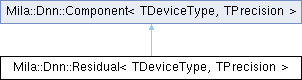
Inheritance diagram for Mila::Dnn::Residual< TDeviceType, TPrecision >:
Public Types | |
| using | ComponentBase = Component<TDeviceType, TPrecision> |
| using | MR = typename DeviceTypeTraits<TDeviceType>::memory_resource |
| using | TensorType = Tensor<TPrecision, MR> |
Public Member Functions | |
| Residual (const std::string &name, const ResidualConfig &config, std::optional< DeviceId > device_id=std::nullopt) | |
| Construct Residual component with optional ExecutionContext ownership. | |
| std::pair< TensorType &, TensorType & > | backward (const TensorType &input_a, const TensorType &input_b, const TensorType &output_grad) |
| Execute the backward pass and return component-owned gradient for input_a. | |
| TensorType & | forward (const TensorType &input_a, const TensorType &input_b) |
| Execute the forward pass and return component-owned output tensor. | |
| DeviceId | getDeviceId () const override |
| Get the compute device id associated with this component. | |
| std::vector< ITensor * > | getGradients () const override |
| Return non-owning pointers to parameter gradient tensors. | |
| MemoryStats | getMemoryStats () const override |
| Return the current memory allocation breakdown for this component. | |
| std::vector< ObservableStage > | getObservableStages () const override |
| Stages this component publishes, and the passes each is published on. | |
| std::vector< const ITensor * > | getOutputs () const override |
| Return non-owning pointers to the tensors this component produces. | |
| std::vector< ITensor * > | getParameters () const override |
| Return non-owning pointers to parameter tensors. | |
| MemoryStats | getRequiredMemory (const BuildContext &context) const override |
| What onBuilding() would allocate for this context, without allocating. | |
| const ComponentType | getType () const override |
| Get the component type identifier. | |
| void | installSharedOutput (std::shared_ptr< TensorType > output) |
| Install a shared output slot (activation pooling). | |
| dim_t | parameterCount () const override |
| Number of trainable parameters. | |
| void | save_ (ModelArchive &, SerializationMode) const override |
| Serialize component parameters into the provided archive. | |
| void | synchronize () override |
| Block until all device operations submitted by this component complete. | |
| std::string | toString () const override |
| Return a human-readable description of the component. | |
| Public Member Functions inherited from Mila::Dnn::Component< TDeviceType, TPrecision > | |
| Component (const std::string &name) | |
| Construct component with required name identifier. | |
| virtual void | build (const BuildContext &context) final |
| Build the component with the provided BuildContext (canonical overload). | |
| IExecutionContext * | getExecutionContext () const |
| Get the shared execution context. | |
| const std::string | getName () const |
| Get the component's name identifier. | |
| Compute::ComputePassMask | getObservedPasses () const noexcept |
| virtual std::vector< std::string > | getParameterNames () const |
| List all available parameter names for this component. | |
| RuntimeMode | getRuntimeMode () const noexcept |
| TrainingMode | getTrainingMode () const noexcept |
| The current runtime behavioral mode of this Component. | |
| virtual bool | isBuilt () const final |
| Returns true if build() has completed successfully. | |
| bool | isInferenceMode () const noexcept |
| bool | isTrainingMode () const noexcept |
| virtual void | load_ (ModelArchive &archive, SerializationMode mode) |
| Restore this component's parameters from its archive scope. | |
| virtual void | loadParameter (const std::string &, const Serialization::ITensorBlob &) |
| Load a parameter from serialized tensor data. | |
| virtual void | requireSerializableParameters () const |
| Verify this component can serialize whatever parameters it owns. | |
| virtual void | saveFlatTensors (Serialization::SafeTensorsWriter &writer, const std::string &prefix, Serialization::TensorSavePass pass) const |
| Drive this component's tensors through one pass of a flat safetensors save. | |
| void | setObservedPasses (Compute::ComputePassMask passes) noexcept |
| Select which passes this component publishes on. | |
| void | setTrainingMode (TrainingMode mode) |
| Set the runtime behavioral mode for this Component. | |
| virtual void | zeroGradients () |
| Clear all model-owned gradients for this component. | |
Protected Member Functions | |
| void | onBuilding (const BuildContext &build_config) override |
| Build the Residual component from the provided BuildContext. | |
| void | onExecutionContextSet () override |
| Hook invoked after ExecutionContext is set on the base Component. | |
| void | onTrainingModeChanging (TrainingMode training_mode) override |
| Hook invoked when training mode is about to change. | |
| Protected Member Functions inherited from Mila::Dnn::Component< TDeviceType, TPrecision > | |
| bool | hasExecutionContext () const noexcept |
| Check if execution context has been set. | |
| template<TensorDataType TParameterPrecision, typename TMemoryResource> | |
| void | loadParameterFromBlob (const std::string ¶m_name, const Serialization::ITensorBlob &blob, Tensor< TParameterPrecision, TMemoryResource > &target, const shape_t &expected_shape) |
| Load a tensor blob into a parameter tensor with validation. | |
| void | publish (Compute::ComputePass pass, std::string_view stage, const ITensor &value) const |
| Publish one activation to the observer, if this pass is being observed. | |
| template<TensorDataType TParameterPrecision, typename TMemoryResource> | |
| void | saveParameterToArchive (ModelArchive &archive, const std::string ¶meter_name, const Tensor< TParameterPrecision, TMemoryResource > ¶meter) const |
| Write one parameter tensor into the archive under "tensors/<name>". | |
| template<TensorDataType TParameterPrecision, typename TMemoryResource> | |
| void | saveParameterToWriter (Serialization::SafeTensorsWriter &writer, const std::string &flat_name, const Tensor< TParameterPrecision, TMemoryResource > ¶meter, Serialization::TensorSavePass pass) const |
| Drive one parameter through one pass of a flat safetensors save. | |
| void | setExecutionContext (IExecutionContext *context) |
| Set the execution context for this component. | |
Additional Inherited Members | |
| Static Public Member Functions inherited from Mila::Dnn::Component< TDeviceType, TPrecision > | |
| static constexpr DeviceType | getDeviceType () |
| Compile-time device type for this component instance. | |
| static constexpr TensorDataType | getPrecision () noexcept |
| Compile-time tensor precision for this component instance. | |
| Protected Types inherited from Mila::Dnn::Component< TDeviceType, TPrecision > | |
| using | HostStagingMemoryResource = typename DeviceTypeTraits<TDeviceType>::host_staging_memory_resource |
| Host memory a device-resident parameter stages through. | |
| Protected Attributes inherited from Mila::Dnn::Component< TDeviceType, TPrecision > | |
| BuildContext | build_context_ { shape_t{ 1 }, RuntimeMode::Training } |
| The BuildContext stored at build time. | |
Detailed Description
template<DeviceType TDeviceType, TensorDataType TPrecision>
requires PrecisionSupportedOnDevice<TPrecision, TDeviceType>
class Mila::Dnn::Residual< TDeviceType, TPrecision >
requires PrecisionSupportedOnDevice<TPrecision, TDeviceType>
class Mila::Dnn::Residual< TDeviceType, TPrecision >
Device-templated Residual connection component.
Delegates binary residual computation to a device-specific backend operation. Parameters (if any) and any projection tensors are stored as Tensor instances bound to the associated execution context.
New API:
- forward(...) returns pointer to a component-owned output ITensor
- backward(...) returns pointer to a component-owned input-gradient for the first input. The component also owns the gradient for the second input which can be accessed via getInputBGrad().
- Template Parameters
-
TDeviceType Device type (DeviceType::Cpu or DeviceType::Cuda). TPrecision Abstract tensor precision (TensorDataType).
Constructor & Destructor Documentation
◆ Residual()
template<DeviceType TDeviceType, TensorDataType TPrecision>
|
inlineexplicit |
Construct Residual component with optional ExecutionContext ownership.
Supports two construction modes:
- Standalone mode (device_id provided): creates and owns an ExecutionContext.
- Shared mode (no device_id): parent must call setExecutionContext() prior to build().
- Parameters
-
name Component name identifier (mandatory). config Residual configuration. device_id Optional device identifier to create owned ExecutionContext.
- Exceptions
-
std::invalid_argument if build_config is invalid or device type mismatches. std::runtime_error if ExecutionContext creation fails (standalone mode).
Member Function Documentation
◆ backward()
template<DeviceType TDeviceType, TensorDataType TPrecision>
|
inline |
Execute the backward pass and return component-owned gradient for input_a.
Component owns both input gradients (for input_a and input_b). The method returns the gradient tensor for input_a. The gradient for input_b can be accessed via getInputBGrad() after calling backward().
- Parameters
-
input_a Left forward input. input_b Right forward input. output_grad Gradient with respect to the component output.
- Returns
- Pointer to component-owned ITensor containing gradient w.r.t. input_a.
- Exceptions
-
std::runtime_error if backend not initialized or if component not built/training.
◆ forward()
template<DeviceType TDeviceType, TensorDataType TPrecision>
|
inline |
Execute the forward pass and return component-owned output tensor.
The returned pointer is owned by the component and is valid until the component is destroyed or rebuilt. The backend BinaryOperation signature is unchanged; the component provides the owned output tensor when invoking the backend.
- Parameters
-
input_a Left input tensor. input_b Right input tensor.
- Returns
- Pointer to component-owned ITensor containing the forward result.
- Exceptions
-
std::runtime_error if component has not been built or backend missing.
◆ getDeviceId()
template<DeviceType TDeviceType, TensorDataType TPrecision>
|
inlineoverridevirtual |
Get the compute device id associated with this component.
Must return the device on which parameters and operations execute.
Implements Mila::Dnn::Component< TDeviceType, TPrecision >.
◆ getGradients()
template<DeviceType TDeviceType, TensorDataType TPrecision>
|
inlineoverridevirtual |
Return non-owning pointers to parameter gradient tensors.
Residual has no trainable parameters by default; return empty list.
Implements Mila::Dnn::Component< TDeviceType, TPrecision >.
◆ getMemoryStats()
template<DeviceType TDeviceType, TensorDataType TPrecision>
|
inlineoverridevirtual |
Return the current memory allocation breakdown for this component.
Reflects allocations at the moment of the call. The returned stats naturally track the component lifecycle:
After construction – nothing; construction allocates none After build( Inference ) – parameters + T=1 state buffers After build( Training ) – parameters + T=full state buffers After setTrainingMode( Train ) – parameters + state + gradients
For CompositeComponent and Network, the returned stats are the recursive aggregate of all child components.
May be called at any time – no lifecycle preconditions.
- Returns
- MemoryStats reflecting current allocations.
Implements Mila::Dnn::Component< TDeviceType, TPrecision >.
◆ getObservableStages()
template<DeviceType TDeviceType, TensorDataType TPrecision>
|
inlineoverridevirtual |
Stages this component publishes, and the passes each is published on.
Lets a caller tell an uninstrumented component from a clean one before running anything. The pass qualifier is load-bearing rather than decorative: the stage set genuinely differs by pass, since a prefill can produce intermediates its decode never materializes.
- Returns
- Vector of stages; empty for components that publish nothing.
Reimplemented from Mila::Dnn::Component< TDeviceType, TPrecision >.
◆ getOutputs()
template<DeviceType TDeviceType, TensorDataType TPrecision>
|
inlineoverridevirtual |
Return non-owning pointers to the tensors this component produces.
The counterpart to getParameters(): that reports what a component HOLDS, this reports what it PRODUCES. Tensors are the built allocations, so their extents are the ceiling a forward pass may narrow within – an observer wanting the live value of a particular call receives it through publication instead.
An empty result means the component does not describe itself. That absence cannot be mistaken for a finding – a view renders no row for it – so no distinction beyond empty is offered.
- Returns
- Vector of output pointers; empty before build, and for undescribed components.
Reimplemented from Mila::Dnn::Component< TDeviceType, TPrecision >.
◆ getParameters()
template<DeviceType TDeviceType, TensorDataType TPrecision>
|
inlineoverridevirtual |
Return non-owning pointers to parameter tensors.
Residual has no trainable parameter tensors by default; return empty list.
Implements Mila::Dnn::Component< TDeviceType, TPrecision >.
◆ getRequiredMemory()
template<DeviceType TDeviceType, TensorDataType TPrecision>
|
inlineoverridevirtual |
What onBuilding() would allocate for this context, without allocating.
See Specifications/MemoryFootprint.md.
Reimplemented from Mila::Dnn::Component< TDeviceType, TPrecision >.
◆ getType()
template<DeviceType TDeviceType, TensorDataType TPrecision>
|
inlineoverridevirtual |
Get the component type identifier.
Used for serialization and runtime type identification.
- Returns
- Component type enum value.
Implements Mila::Dnn::Component< TDeviceType, TPrecision >.
◆ installSharedOutput()
template<DeviceType TDeviceType, TensorDataType TPrecision>
|
inline |
Install a shared output slot (activation pooling).
Must be called before build(): onBuilding then skips output self-allocation after validating the slot's storage covers the build shape, and forward() always returns a shape-adjusted view so a wider slot never leaks its geometry to callers. Mirrors Linear::installSharedWeight; self-allocation remains the default. The slot is owned and memory-accounted by the installer.
◆ onBuilding()
template<DeviceType TDeviceType, TensorDataType TPrecision>
|
inlineoverrideprotectedvirtual |
Build the Residual component from the provided BuildContext.
Allocates the component-owned output buffer and, for Training-mode builds, the gradient buffers for both inputs.
Output buffer
The output buffer matches the full input shape. Residual is a pure elementwise addition with no sequence dimension concern – RuntimeMode does not influence output buffer allocation.
Gradient buffers
input_a_grad_ and input_b_grad_ are allocated only for RuntimeMode::Training builds. Both are the same shape as the input – Residual is elementwise addition and both inputs are always symmetric in shape.
- Parameters
-
build_config Full input shape and RuntimeMode for this build.
Reimplemented from Mila::Dnn::Component< TDeviceType, TPrecision >.
◆ onExecutionContextSet()
template<DeviceType TDeviceType, TensorDataType TPrecision>
|
inlineoverrideprotectedvirtual |
Hook invoked after ExecutionContext is set on the base Component.
Create the device-specific BinaryOperation backend via the OperationRegistry.
Reimplemented from Mila::Dnn::Component< TDeviceType, TPrecision >.
◆ onTrainingModeChanging()
template<DeviceType TDeviceType, TensorDataType TPrecision>
|
inlineoverrideprotectedvirtual |
Hook invoked when training mode is about to change.
Inform backend operation of the new training mode. When leaving training, explicitly unbind any parameter-gradient pointers on the backend to avoid accidental use or pinned memory.
Called with Component's training mutex held; do not call setTrainingMode() here.
Reimplemented from Mila::Dnn::Component< TDeviceType, TPrecision >.
◆ parameterCount()
template<DeviceType TDeviceType, TensorDataType TPrecision>
|
inlineoverridevirtual |
Number of trainable parameters.
Residual has no trainable parameters.
- Returns
- 0
Implements Mila::Dnn::Component< TDeviceType, TPrecision >.
◆ save_()
template<DeviceType TDeviceType, TensorDataType TPrecision>
|
inlineoverridevirtual |
Serialize component parameters into the provided archive.
Placeholder; concrete implementations should write named parameter tensors into the archive.
Implements Mila::Dnn::Component< TDeviceType, TPrecision >.
◆ synchronize()
template<DeviceType TDeviceType, TensorDataType TPrecision>
|
inlineoverridevirtual |
Block until all device operations submitted by this component complete.
- Exceptions
-
std::runtime_error if ExecutionContext has not been set.
Implements Mila::Dnn::Component< TDeviceType, TPrecision >.
◆ toString()
template<DeviceType TDeviceType, TensorDataType TPrecision>
|
inlineoverridevirtual |
Return a human-readable description of the component.
Includes configured name, training/built state, backend presence, device information and parameter count to aid debugging and logging.
Implements Mila::Dnn::Component< TDeviceType, TPrecision >.
The documentation for this class was generated from the following file:
- Mila/Src/Dnn/Components/Connections/Residual.ixx