Loading...
Searching...
No Matches
Mila::Dnn::GptBlock< TDeviceType, TPrecision > Class Template Referenceexport
module Dnn.Components.GptBlock
Transformer encoder block as a composite component. More...
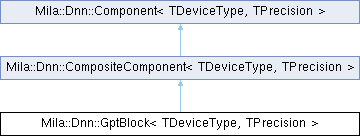
Inheritance diagram for Mila::Dnn::GptBlock< TDeviceType, TPrecision >:
Public Types | |
| using | AttentionType = MultiHeadAttention<TDeviceType, TPrecision> |
| using | ComponentPtr = typename CompositeComponentBase::ComponentPtr |
| using | CompositeComponentBase = CompositeComponent<TDeviceType, TPrecision> |
| using | ExecutionContextType = ExecutionContext<TDeviceType> |
| using | LayerNormType = LayerNorm<TDeviceType, TPrecision> |
| using | LinearType = Linear<TDeviceType, TPrecision> |
| using | MLPType = MLP<TDeviceType, TPrecision> |
| using | MR = typename DeviceTypeTraits<TDeviceType>::memory_resource |
| using | ResidualType = Residual<TDeviceType, TPrecision> |
| using | TensorType = Tensor<TPrecision, MR> |
| Public Types inherited from Mila::Dnn::CompositeComponent< TDeviceType, TPrecision > | |
| using | ComponentBase = Component<TDeviceType, TPrecision> |
| using | ComponentPtr = std::shared_ptr<Component<TDeviceType, TPrecision>> |
Public Member Functions | |
| GptBlock (const std::string &name, const GptBlockConfig &config, std::optional< DeviceId > device_id=std::nullopt) | |
| Construct GptBlock in shared or standalone mode. | |
| TensorType & | backward (const TensorType &input, const TensorType &output_grad) |
| Backward pass returning the input-gradient tensor. | |
| TensorType & | decode (const TensorType &input, dim_t position) |
| Inference-only single-token decode pass. | |
| TensorType & | forward (const TensorType &input) |
| Forward pass with optional KV cache dispatch. | |
| MemoryStats | getMemoryStats () const override |
| Return the current memory allocation breakdown for this component. | |
| std::vector< ObservableStage > | getObservableStages () const override |
| Stages this component publishes, and the passes each is published on. | |
| const ComponentType | getType () const override |
| Get the component type identifier. | |
| void | initializeKvCache (int64_t max_seq_len) |
| Allocate KV cache buffers on the contained Attention component. | |
| void | resetKvCache () |
| Reset KV cache state on the contained Attention component. | |
| bool | supportsKvCache () const noexcept |
| Returns true when the contained Attention supports KV caching. | |
| std::string | toString () const override |
| Generate a human-readable description. | |
| void | zeroGradients () override |
| Clear all model-owned gradients for this component. | |
| Public Member Functions inherited from Mila::Dnn::CompositeComponent< TDeviceType, TPrecision > | |
| CompositeComponent (CompositeComponent &&) noexcept=default | |
| CompositeComponent (const CompositeComponent &)=delete | |
| CompositeComponent (const std::string &name) | |
| Construct composite component with name. | |
| CompositeComponent & | addComponent (ComponentPtr component) |
| Add a pre-constructed child component (chainable). | |
| size_t | childCount () const noexcept |
| Get the number of direct children. | |
| void | clearComponents () |
| Clear all child components. | |
| std::vector< std::string > | componentPaths () const |
| Every component path in this subtree, in traversal order. | |
| ComponentPtr | findComponent (const std::string &path) const |
| Resolve a dot-separated component path within this composite. | |
| ComponentPtr | getComponent (const std::string &name) const |
| Retrieve a direct child component by name. | |
| const std::vector< ComponentPtr > & | getComponents () const |
| Get all child components in insertion order. | |
| DeviceId | getDeviceId () const override |
| Get the compute device for this composite. | |
| std::vector< ITensor * > | getGradients () const override |
| Get all parameter gradients from all children. | |
| std::vector< ITensor * > | getParameters () const override |
| Get all parameters from all children. | |
| bool | hasChildren () const noexcept |
| Check if this composite has any children. | |
| bool | hasComponent (const std::string &name) const |
| Check if a named child component exists. | |
| size_t | observe (std::string_view pattern, Compute::ComputePassMask passes, Compute::ActivationObserver sink) |
| Attach sink to every component in this subtree whose path matches. | |
| CompositeComponent & | operator= (CompositeComponent &&) noexcept=default |
| CompositeComponent & | operator= (const CompositeComponent &)=delete |
| dim_t | parameterCount () const override |
| Count parameters across all children. | |
| bool | removeComponent (const std::string &name) |
| Remove a child component by name. | |
| void | saveFlatTensors (Serialization::SafeTensorsWriter &writer, const std::string &prefix, Serialization::TensorSavePass pass) const override |
| Recurse into children, extending the flat dotted prefix. | |
| void | stopObserving () |
| Detach every observer in this subtree and clear the shared sink. | |
| void | synchronize () override |
| Synchronize all child components. | |
| ComponentPtr | tryFindComponent (const std::string &path) const |
| Try to resolve a dot-separated component path within this composite. | |
| Public Member Functions inherited from Mila::Dnn::Component< TDeviceType, TPrecision > | |
| Component (const std::string &name) | |
| Construct component with required name identifier. | |
| virtual void | build (const BuildContext &context) final |
| Build the component with the provided BuildContext (canonical overload). | |
| IExecutionContext * | getExecutionContext () const |
| Get the shared execution context. | |
| const std::string | getName () const |
| Get the component's name identifier. | |
| Compute::ComputePassMask | getObservedPasses () const noexcept |
| virtual std::vector< const ITensor * > | getOutputs () const |
| Return non-owning pointers to the tensors this component produces. | |
| virtual std::vector< std::string > | getParameterNames () const |
| List all available parameter names for this component. | |
| virtual MemoryStats | getRequiredMemory (const BuildContext &context) const |
| Report what build( context ) would allocate, without allocating it. | |
| RuntimeMode | getRuntimeMode () const noexcept |
| TrainingMode | getTrainingMode () const noexcept |
| The current runtime behavioral mode of this Component. | |
| virtual bool | isBuilt () const final |
| Returns true if build() has completed successfully. | |
| bool | isInferenceMode () const noexcept |
| bool | isTrainingMode () const noexcept |
| virtual void | loadParameter (const std::string &, const Serialization::ITensorBlob &) |
| Load a parameter from serialized tensor data. | |
| void | setObservedPasses (Compute::ComputePassMask passes) noexcept |
| Select which passes this component publishes on. | |
| void | setTrainingMode (TrainingMode mode) |
| Set the runtime behavioral mode for this Component. | |
Protected Member Functions | |
| void | onBuilding (const BuildContext &context) override |
| Hook invoked by build() to allocate component buffers. | |
| void | onTrainingModeChanging (TrainingMode training_mode) override |
| Hook invoked when training mode is about to change. | |
| Protected Member Functions inherited from Mila::Dnn::CompositeComponent< TDeviceType, TPrecision > | |
| template<typename TComponent> | |
| std::shared_ptr< TComponent > | getComponentAs (const std::string &name) const |
| Retrieve a typed child component by name. | |
| void | load_ (ModelArchive &archive, SerializationMode mode) override |
| Restore children from their nested scopes, mirroring save_(). | |
| void | onExecutionContextSet () override |
| Hook invoked after ExecutionContext is set. | |
| virtual void | optimize () |
| Virtual hook for graph optimization after construction. | |
| void | requireSerializableParameters () const override |
| No-op override: a composite names no parameters of its own. | |
| void | save_ (ModelArchive &archive, SerializationMode mode) const override |
| Protected Member Functions inherited from Mila::Dnn::Component< TDeviceType, TPrecision > | |
| bool | hasExecutionContext () const noexcept |
| Check if execution context has been set. | |
| template<TensorDataType TParameterPrecision, typename TMemoryResource> | |
| void | loadParameterFromBlob (const std::string ¶m_name, const Serialization::ITensorBlob &blob, Tensor< TParameterPrecision, TMemoryResource > &target, const shape_t &expected_shape) |
| Load a tensor blob into a parameter tensor with validation. | |
| void | publish (Compute::ComputePass pass, std::string_view stage, const ITensor &value) const |
| Publish one activation to the observer, if this pass is being observed. | |
| template<TensorDataType TParameterPrecision, typename TMemoryResource> | |
| void | saveParameterToArchive (ModelArchive &archive, const std::string ¶meter_name, const Tensor< TParameterPrecision, TMemoryResource > ¶meter) const |
| Write one parameter tensor into the archive under "tensors/<name>". | |
| template<TensorDataType TParameterPrecision, typename TMemoryResource> | |
| void | saveParameterToWriter (Serialization::SafeTensorsWriter &writer, const std::string &flat_name, const Tensor< TParameterPrecision, TMemoryResource > ¶meter, Serialization::TensorSavePass pass) const |
| Drive one parameter through one pass of a flat safetensors save. | |
| void | setExecutionContext (IExecutionContext *context) |
| Set the execution context for this component. | |
Additional Inherited Members | |
| Static Public Member Functions inherited from Mila::Dnn::Component< TDeviceType, TPrecision > | |
| static constexpr DeviceType | getDeviceType () |
| Compile-time device type for this component instance. | |
| static constexpr TensorDataType | getPrecision () noexcept |
| Compile-time tensor precision for this component instance. | |
| Protected Types inherited from Mila::Dnn::Component< TDeviceType, TPrecision > | |
| using | HostStagingMemoryResource = typename DeviceTypeTraits<TDeviceType>::host_staging_memory_resource |
| Host memory a device-resident parameter stages through. | |
| Protected Attributes inherited from Mila::Dnn::Component< TDeviceType, TPrecision > | |
| BuildContext | build_context_ { shape_t{ 1 }, RuntimeMode::Training } |
| The BuildContext stored at build time. | |
Detailed Description
template<DeviceType TDeviceType, TensorDataType TPrecision>
requires PrecisionSupportedOnDevice<TPrecision, TDeviceType>
class Mila::Dnn::GptBlock< TDeviceType, TPrecision >
requires PrecisionSupportedOnDevice<TPrecision, TDeviceType>
class Mila::Dnn::GptBlock< TDeviceType, TPrecision >
Transformer encoder block as a composite component.
Device-templated composite component that composes: LayerNorm -> QKV projection -> MultiHeadSelfAttention -> Residual -> LayerNorm -> MLP -> Residual
Construction follows the same patterns used by the MLP block:
- Graph created in constructor (context-independent)
- Optional owned ExecutionContext when a DeviceId is provided
- Shape-dependent build occurs in onBuilding()
KV cache support is surfaced via supportsKvCache() and managed via initializeKvCache() / resetKvCache(), which delegate to the contained Attention component. The KV cache dispatch itself is entirely driven by the AttentionForwardContext passed to forward() - GptBlock has no separate forwardPrefill / forwardDecode methods.
The AttentionForwardContext partition is imported but not re-exported. Only GptBlock and GptTransformer (and future transformer implementations) need visibility into it.
Constructor & Destructor Documentation
◆ GptBlock()
template<DeviceType TDeviceType, TensorDataType TPrecision>
|
inlineexplicit |
Construct GptBlock in shared or standalone mode.
- Parameters
-
name Component name (used as prefix for sub-components). config Validated configuration for the block. device_id Optional DeviceId. When provided and matching TDeviceType, an owned ExecutionContext is created (standalone mode). Otherwise a parent is expected to set the context (shared mode).
Member Function Documentation
◆ backward()
template<DeviceType TDeviceType, TensorDataType TPrecision>
|
inline |
Backward pass returning the input-gradient tensor.
- Parameters
-
input Forward input previously passed to forward(). output_grad Gradient w.r.t. this block's output.
- Returns
- Reference to the owned input-gradient tensor.
◆ decode()
template<DeviceType TDeviceType, TensorDataType TPrecision>
|
inline |
Inference-only single-token decode pass.
Runs all components with their standard forward() except Attention, which is called via decode(). Attention internally selects the fast KV cache path when available, or falls back to forward().
GptBlock is entirely unaware of which path Attention takes – the decode/fallback decision is Attention's private concern.
Precondition: forward() must have been called at least once on this block (via GptTransformer::forward or GptModel prefill pass) to populate the KV cache before decode() is called.
- Parameters
-
input Single-token input [B, 1, embedding_dim]. position Current sequence position (0-based).
- Returns
- Reference to block output tensor.
◆ forward()
template<DeviceType TDeviceType, TensorDataType TPrecision>
|
inline |
Forward pass with optional KV cache dispatch.
The default context (Mode::Standard) is the training and CPU inference path. During generate(), GptTransformer supplies a context with Mode::Prefill or Mode::Decode which is forwarded transparently to the contained Attention component. GptBlock itself has no awareness of prefill vs. decode semantics beyond passing the context through.
- Parameters
-
input Forward input tensor of shape [B, T, embedding_dim].
- Returns
- Reference to the block output tensor.
◆ getMemoryStats()
template<DeviceType TDeviceType, TensorDataType TPrecision>
|
inlineoverridevirtual |
Return the current memory allocation breakdown for this component.
Reflects allocations at the moment of the call. The returned stats naturally track the component lifecycle:
After construction – nothing; construction allocates none After build( Inference ) – parameters + T=1 state buffers After build( Training ) – parameters + T=full state buffers After setTrainingMode( Train ) – parameters + state + gradients
For CompositeComponent and Network, the returned stats are the recursive aggregate of all child components.
May be called at any time – no lifecycle preconditions.
- Returns
- MemoryStats reflecting current allocations.
Implements Mila::Dnn::Component< TDeviceType, TPrecision >.
◆ getObservableStages()
template<DeviceType TDeviceType, TensorDataType TPrecision>
|
inlineoverridevirtual |
Stages this component publishes, and the passes each is published on.
Lets a caller tell an uninstrumented component from a clean one before running anything. The pass qualifier is load-bearing rather than decorative: the stage set genuinely differs by pass, since a prefill can produce intermediates its decode never materializes.
- Returns
- Vector of stages; empty for components that publish nothing.
Reimplemented from Mila::Dnn::Component< TDeviceType, TPrecision >.
◆ getType()
template<DeviceType TDeviceType, TensorDataType TPrecision>
|
inlineoverridevirtual |
Get the component type identifier.
Used for serialization and runtime type identification.
- Returns
- Component type enum value.
Implements Mila::Dnn::Component< TDeviceType, TPrecision >.
◆ initializeKvCache()
template<DeviceType TDeviceType, TensorDataType TPrecision>
|
inline |
Allocate KV cache buffers on the contained Attention component.
Intended to be called exclusively by the owning transformer's generate() during session setup.
- Parameters
-
max_seq_len Maximum sequence length the cache must accommodate.
◆ onBuilding()
template<DeviceType TDeviceType, TensorDataType TPrecision>
|
inlineoverrideprotectedvirtual |
Hook invoked by build() to allocate component buffers.
Receives the stored BuildContext. Implementations must use config.allocationSeqLen() when sizing output buffers – this is the single call that makes Inference and Training allocate the correct buffer sizes automatically without per-component logic.
// Example -- Linear component:
shape_t out_shape =
{
config.batchSize(),
config.allocationSeqLen(), // 1 for Inference, T for Training
config_.getOutputFeatures()
};
output_ = std::make_unique<TensorType>( device, out_shape,
this->getName() + ".output" );
TensorShape shape_t
Row-major shape descriptor for tensor dimensional sizes.
Definition Tensor.Types.ixx:173
const std::string getName() const
Get the component's name identifier.
Definition Component.ixx:522
The default implementation forwards to the legacy onBuilding( const shape_t& ) overload for backwards compatibility. New components should override this overload directly.
- Note
- Do not call build() or onBuilding() from within this hook.
- Implementations should either succeed fully or leave no partial state, as a failed build() may be retried.
Takes the build-time configuration; use its allocationSeqLen() to obtain the correct output buffer sequence dimension.
Reimplemented from Mila::Dnn::Component< TDeviceType, TPrecision >.
◆ onTrainingModeChanging()
template<DeviceType TDeviceType, TensorDataType TPrecision>
|
inlineoverrideprotectedvirtual |
Hook invoked when training mode is about to change.
Propagates the new mode to all child components. The hook runs with the Component's training mutex held; it MUST NOT call setTrainingMode().
- Parameters
-
training_mode New training mode (Normal or Eval)
Reimplemented from Mila::Dnn::CompositeComponent< TDeviceType, TPrecision >.
◆ resetKvCache()
template<DeviceType TDeviceType, TensorDataType TPrecision>
|
inline |
Reset KV cache state on the contained Attention component.
Intended to be called exclusively by the owning transformer's generate() between independent generation requests.
◆ supportsKvCache()
template<DeviceType TDeviceType, TensorDataType TPrecision>
|
inlinenoexcept |
Returns true when the contained Attention supports KV caching.
Propagates the capability query up from Attention without exposing IKvCacheable directly. GptTransformer uses this to decide whether generate() can take the fast decode path.
◆ toString()
template<DeviceType TDeviceType, TensorDataType TPrecision>
|
inlineoverridevirtual |
Generate a human-readable description.
- Returns
- String representation showing children
Reimplemented from Mila::Dnn::CompositeComponent< TDeviceType, TPrecision >.
◆ zeroGradients()
template<DeviceType TDeviceType, TensorDataType TPrecision>
|
inlineoverridevirtual |
Clear all model-owned gradients for this component.
Default implementation is a no-op. Composite components should override to recurse to children. Leaf components should override to zero their parameter and activation gradients using device-aware helpers.
Reimplemented from Mila::Dnn::Component< TDeviceType, TPrecision >.
The documentation for this class was generated from the following file:
- Mila/Src/Dnn/Components/Transformers/Gpt/GptBlock.ixx